Construction companies in Saudi Arabia often struggle to keep full control over their equipment. Assets move between jobsites, yards, and subcontractors, while data on fuel use, machine hours, and maintenance is often delayed or recorded manually. As a result, contractors do not always know which equipment is working, which is idle, which units need service, and which project is actually carrying the cost.
On large construction projects, these issues can quickly lead to higher costs, downtime, and schedule pressure. As construction activity accelerates under Vision 2030, contractors need better control over fleet performance across projects. Modern fleet management solutions for Saudi Arabia help reduce these risks by giving companies more accurate equipment data, better maintenance planning, and clearer cost visibility.
In this article, we explain what fleet management means in construction, why it matters in Saudi Arabia, and how modern tools and processes can help contractors deliver projects more efficiently.
Fleet Management: Meaning
Fleet management is the process of tracking, maintaining, and coordinating the vehicles, equipment, and other assets a company uses in operations.
In construction, fleet management is different from traditional vehicle fleet management. Standard fleets are usually managed around mileage, routes, and driver activity. Construction fleets are managed around engine hours, utilization, idle time, equipment condition, and project demand.
Construction assets also move more often between jobsites, yards, and subcontractors. In addition, construction fleets are mixed fleets that may include heavy equipment, trucks, trailers, and tools. This makes fleet management more complex and more important for cost control, maintenance planning, and equipment availability.
What is a Fleet Management System
A fleet management system is a digital solution that helps construction companies monitor, manage, and optimize vehicles, equipment, and other fleet assets from one place. It gives managers visibility into asset location, utilization, fuel use, maintenance needs, and operating status.
For construction companies, a fleet management system is especially useful because it supports mixed fleets and project-based operations. Instead of focusing only on road vehicles, it helps track heavy equipment, trailers, and other jobsite assets across different locations. This makes it easier to reduce idle time, plan maintenance, control costs, and keep the right equipment available for each project.
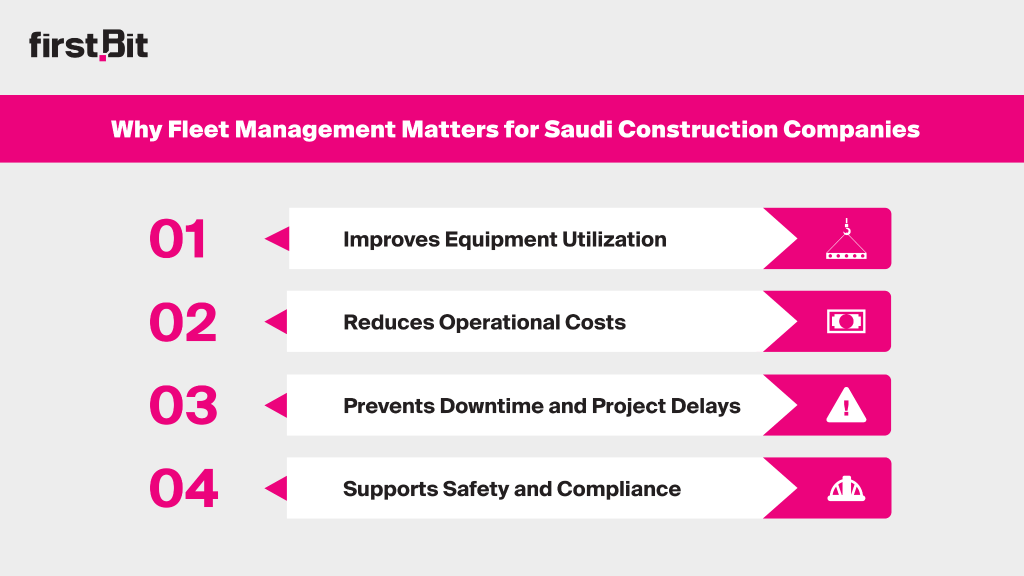
Why Fleet Management Matters for Saudi Construction Companies
Fleet management matters in Saudi Arabia because contractors are working in a market shaped by large-scale
Vision 2030 projects and continued construction growth. As project activity expands, companies need better control over where equipment is, how often it is used, and whether it is available when a project needs it.
Study shows modern fleet management gives contractors measurable results across cost control, maintenance, and project reliability. Industry data shows that telematics-based fleet management can reduce fuel costs by 20–25%, cut unplanned downtime by 30–40%, lower maintenance costs by 25–30%, and reduce accident rates by 20–30%[?].
For construction companies, these indicators show the practical value of better fleet visibility, earlier maintenance action, and tighter control over equipment performance across projects.
Why Fleet Management Matters for Saudi Construction Companies
For Saudi contractors, strong fleet management improves both cost control and schedule reliability. Tracking fuel use, maintenance needs, and asset utilization helps reduce waste, prevent breakdowns, and keep equipment ready for active projects. On large, fast-moving jobs, that directly supports productivity and helps protect margins.
Improves Equipment Utilization
Fleet management helps Saudi contractors improve equipment utilization because it shows where each asset is, how often it is used, and whether it is sitting idle. That matters in a market where construction activity and equipment demand continue to grow alongside Vision 2030 projects. Better visibility makes it easier to move assets between jobsites instead of leaving equipment underused in yards or renting units that are already available elsewhere.
This is especially important for construction fleets because performance is measured by engine hours, runtime, and idle time, not just mileage. Telematics and mixed-fleet tracking tools help managers identify underused machines, reduce wasted idle time, and make faster deployment decisions across projects.
Reduces Operational Costs
Fleet management helps Saudi contractors reduce operating costs by showing where money is being lost in daily equipment use. Fuel, idle time, avoidable rentals, and poorly timed maintenance all increase the cost of running a fleet. When managers track fuel burn, engine hours, and idle time, they can spot inefficient usage and take action earlier. Caterpillar notes that idle time drives up fuel costs quickly and can represent a major share of machine fuel consumption.
It also lowers costs by improving maintenance planning. Telematics data helps managers monitor service hours, equipment condition, and utilization in one view, which supports better repair timing and helps reduce unnecessary downtime. For Saudi companies handling large, active project pipelines, this matters because better fleet control helps protect margins as equipment demand grows with ongoing Vision 2030 development.
Prevents Downtime and Project Delays
Fleet management helps prevent downtime because it gives teams earlier visibility into service needs, fault codes, and equipment condition. Instead of waiting for a breakdown, managers can schedule maintenance based on engine hours and machine data. This reduces the risk of unexpected failures that can stop work and delay the next stage of a project. John Deere notes that telematics and machine health data help contractors identify issues earlier and plan maintenance more effectively.
Construction requires awareness of available assets, as their unavailability affects everything. Contractors can maintain projects with fewer disruptions when they know machine status. For Saudi companies working across multiple active sites, this level of control enables more reliable scheduling and optimal fleet utilization.
Supports Safety and Compliance
Fleet management also helps Saudi construction companies improve safety and compliance across vehicles, equipment, and jobsites. In Saudi Arabia, the Ministry of Human Resources and Social Development states that the Labor Law addresses worker safety, protection, and health, and it also sets rules for working hours and breaks.
The ministry’s 2026 construction-site guidance further emphasizes that occupational safety is not only about formal rules, but also about worker awareness, hazard prevention, and making safe behavior part of daily operations.
For contractors, this makes fleet visibility more than an operational issue. It becomes part of risk control. When companies track operator behavior, equipment condition, inspections, and service records in one system, they are in a better position to reduce unsafe equipment use, respond faster to issues, and maintain documentation needed for internal controls and external requirements. Telematics tools can also support safety and performance monitoring across mixed fleets, including heavy equipment and non-road assets.
Fleet Management Solutions in Saudi Arabia
Saudi construction companies increasingly use digital fleet management solutions to improve visibility, control costs, and keep equipment available across multiple projects. These solutions typically combine telematics, GPS tracking, software platforms, and data analytics to help contractors monitor assets, maintenance, fuel use, and utilization in one system.
Telematics and IoT Sensors
Telematics and IoT sensors provide real-time data from construction equipment in the field. They collect information such as engine hours, fuel consumption, idle time, operating status, fault codes, and equipment location. This helps fleet managers understand how assets are being used and identify maintenance needs earlier.
These tools improve control over mixed fleets working across multiple jobsites. Instead of relying on manual updates, managers can use live equipment data to monitor usage, reduce unnecessary idling, schedule maintenance based on actual engine hours, and respond faster to equipment issues. This supports better utilization, lower operating costs, and more reliable equipment availability across projects.
GPS and Asset Tracking Systems
In Saudi Arabia, GPS and asset tracking systems help construction companies maintain visibility over equipment across large project areas, storage yards, and subcontractor locations. This is especially relevant in a market shaped by major Vision 2030 developments across the Kingdom.
Saudi Arabia’s geospatial authority also states that the country covers approximately 2 million square kilometers and that geospatial data is necessary to support the planning and implementation of existing and new projects. For contractors evaluating a fleet management system in Saudi Arabia, the value of these tools lies not only in tracking equipment, but also in connecting usage, maintenance, and cost data across projects.
Broader regulatory focus on geospatial systems and transport tracking also makes GPS-based asset control more relevant for contractors.
GEOSA oversees the geospatial sector, and the Transport General Authority regulates truck management and tracking providers. Asset tracking fits into a wider operating environment where location accuracy and movement control are becoming more important for project execution.
Fleet Management Software Platforms
Fleet management software platforms give Saudi construction companies a centralized dashboard for managing vehicles, equipment, and maintenance in one place. Instead of using spreadsheets, separate telematics portals, and manual service logs, fleet teams can view asset location, equipment status, maintenance schedules, and service records through one system.
This makes it easier to track which assets are available, which units need maintenance, and which equipment is assigned to active projects. For Saudi contractors managing multiple sites, a centralized dashboard improves record consistency and gives teams a clearer view of fleet activity across operations.
AI and Predictive Analytics
AI and predictive analytics are becoming more relevant in Saudi Arabia as the Kingdom advances its National Strategy for Data & AI under Vision 2030 and continues expanding its digital economy. Saudi government sources treat AI as part of the country’s broader modernization and data-driven decision-making agenda
[?].
In fleet management, AI is used to analyze telematics and equipment data such as fuel use, idle time, fault codes, and service intervals. This supports earlier detection of maintenance risks and more accurate equipment planning by project demand. Saudi official channels have also linked AI with predictive maintenance and asset sustainability in wider asset-management discussions.
Best Practices for Fleet Management Process in Saudi Arabia
For Saudi construction companies, fleet management is more effective when processes are standardized across projects, yards, and support teams. This matters in a market shaped by large Vision 2030 developments and broader digital transformation, where contractors need consistent asset records, maintenance data, and equipment status across operations.
In practice, strong fleet processes in Saudi Arabia are built around centralized data, project-based equipment tracking, preventive maintenance, operator discipline, and system integration. These practices give contractors clearer control over fleet availability, service planning, and cost visibility across active jobs.
Implement Centralized Fleet Management Software
For Saudi construction companies, a centralized construction equipment fleet management software creates one system for vehicles, equipment, and maintenance records across projects. This fits the Kingdom’s broader digital transformation agenda and growing use of cloud-based systems. Saudi policy also encourages cloud adoption, including in the private sector.
Using one platform instead of spreadsheets and separate portals helps standardize asset records, maintenance schedules, fuel data, and utilization data across jobsites and yards. It also reduces duplicate records and makes fleet data easier to review across operations.
Pro tip
Before choosing a fleet management system, define how each asset should be recorded, named, assigned to projects, and updated. Clean data rules make the software much easier to scale across jobsites.
Track Equipment Utilization by Project
Saudi construction companies should track equipment utilization by project, not only by asset. In practice, this means linking engine hours, runtime, idle time, and fuel use to a specific jobsite or contract package. That approach is especially important in a market shaped by multiple large-scale Vision 2030 developments running across the Kingdom.
Project-based tracking gives contractors a clearer view of where equipment is creating value and where it is underused. It also improves job costing, internal allocation, and redeployment decisions across active projects. Instead of reviewing fleet data only at the asset level, managers can compare utilization by project and identify units that should be moved, serviced, or replaced.
Pro tip
Consider tracking idle time together with engine hours. High engine hours can suggest strong utilization, but if much of that time is idle, the equipment may be using fuel without adding real value to the project.
Develop Preventive Maintenance Programs
Saudi construction companies should build preventive maintenance programs around engine hours, equipment condition, and service history rather than fixed calendar intervals alone. That approach aligns better with construction equipment, where wear depends on actual usage in the field. Saudi official sources also recognize both preventive maintenance and predictive maintenance as established asset-management approaches.
In practice, this means setting service schedules from machine data, documenting maintenance activity consistently, and using fault and inspection data to catch issues earlier. Saudi standards and government guidance also support documented maintenance and proactive asset care in broader safety and asset-management contexts.
Train Operators and Drivers
Saudi construction companies should make operator and driver training a formal part of fleet management, not only a site-level safety task. This aligns with Saudi labor rules: recent Labor Law amendments state that employers are responsible for training Saudi workers and improving their technical and professional skills, while Saudi safety standards also require trained operators for equipment such as cranes.
In practice, this means combining training with operator monitoring. Companies can use telematics and driver data to track speeding, harsh driving, excessive idling, and other unsafe patterns, then use that information for coaching, refreshers, and internal safety controls. For Saudi contractors, this supports safer equipment use and more consistent operating standards across projects.
Pro tip
Use operator data as a coaching tool before treating it as a control measure. When drivers and operators understand which habits increase fuel use, downtime, or safety risk, they are more likely to improve their behavior consistently.
Integrate Fleet Data with Construction Management Systems
Saudi construction companies should integrate fleet data with ERP, accounting, procurement, and project management systems instead of keeping it in separate tools. In Saudi Arabia, official digital policy increasingly emphasizes integration, interoperability, and data sharing, while the Kingdom’s Cloud First Policy has supported broader adoption of cloud-based systems.
For contractors, the same principle applies at the operational level: when fleet data is connected with project and finance systems, equipment usage, maintenance records, fuel costs, and job-level reporting are easier to manage in one process. This reduces duplicate entry and improves record consistency across departments and projects.
Pro tip
Start with integrations that remove the most manual work, such as fuel costs, maintenance records, purchase orders, and project-level equipment usage. These areas often create the fastest operational benefit for contractors.
Key Features of the Modern Construction Equipment Fleet Management Software
Modern fleet management software for Saudi construction companies is designed to handle mixed fleets, large project volumes, and complex equipment movement across jobsites. Instead of focusing only on vehicle tracking, these systems combine telematics, analytics, and operational tools to give contractors full control over fleet performance
Real-Time Asset Tracking
Real-time asset tracking allows companies to see the exact location of equipment, vehicles, and tools across jobsites, yards, and subcontractor locations. GPS and telematics systems provide continuous updates, which is especially important in Saudi Arabia where projects are often spread across large geographic areas.
This level of visibility helps prevent equipment loss, reduce unauthorized use, and improve dispatch decisions. Managers can quickly identify where assets are located and move them between projects based on demand.
Equipment Utilization Monitoring
Fleet software tracks engine hours, runtime, idle time, and usage patterns for each asset. This gives contractors a clear picture of how equipment is actually being used in the field.
For Saudi construction companies, this is critical because utilization directly affects profitability. By identifying underused machines or excessive idle time, managers can improve allocation, reduce waste, and increase overall productivity across projects.
Preventive and Predictive Maintenance
Modern systems support both preventive and predictive maintenance. Preventive maintenance schedules are based on engine hours and service intervals, while predictive maintenance uses data such as fault codes and performance trends to detect potential issues earlier.
This helps reduce unexpected breakdowns, extend equipment lifespan, and keep assets available for active projects. For contractors working on tight schedules, better maintenance planning directly supports project continuity.
Fuel Management and Cost Control
Fuel is one of the largest operating costs in construction fleets. Fleet management software tracks fuel consumption, idle time, and refueling patterns to identify inefficiencies. Saudi contractors can use this data to reduce excessive idling, detect abnormal fuel usage, and improve operator behavior. Over time, this leads to lower fuel costs and better control over overall fleet expenses.
Safety Monitoring and Driver Behavior Analysis
Сonstruction equipment fleet management software systems monitor driver and operator behavior, including speeding, harsh braking, rapid acceleration, and excessive idling. Many platforms provide driver scorecards and real-time alerts. For Saudi construction companies, this supports both safety and compliance. Monitoring helps reduce risky behavior, improve operator performance, and create a safer working environment across jobsites.
Compliance and Inspection Management
Fleet management software also helps companies manage inspections, certifications, and compliance records. Digital checklists, inspection logs, and maintenance documentation are stored in one system.
This is important in Saudi Arabia, where contractors must maintain safety records, equipment inspections, and operational documentation. Centralized records make it easier to meet internal standards and external regulatory requirements.
How FirstBit ERP Helps Saudi Construction Companies Optimize
FirstBit ERP helps Saudi construction companies control fleet operations by connecting equipment usage with finance, maintenance, and project data in one system.
Instead of treating fleet as a separate function, the system connects equipment data from tracking systems with ERP records, so usage, fuel, and maintenance are automatically assigned to the right equipment and reflected in project costs without manual entry.
With
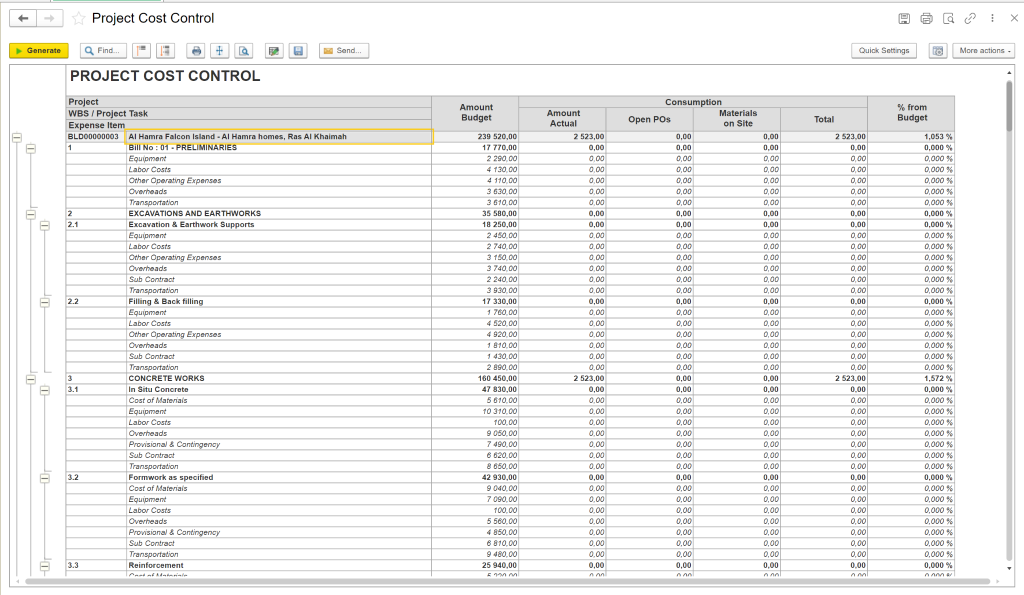
First Bit ERP, fleet-related costs can be connected directly to project costing. Equipment, transportation, fuel, repair, and maintenance expenses become visible at the project or WBS level, helping teams compare budgeted and actual costs in one place.
Project cost control in FirstBit ERP provides crews with clear visibility into project-level costs and equipment-related expenses
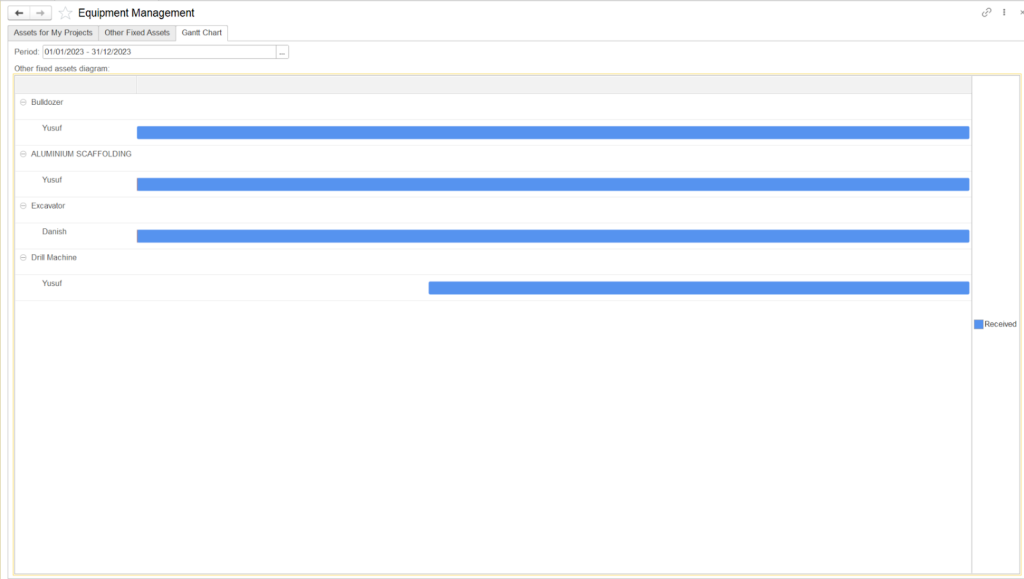
Built for the Saudi construction industry, our ERP helps crews see which equipment is assigned to each project and when it is available. This supports better planning across jobsites and reduces the risk of equipment being underused or double-booked.
Equipment management view helps crews track asset allocation and availability across project timelines.
Maintenance and spare parts data can also be managed in the same workflow. Crews can track completed service work, equipment used, repair records, and parts issued for maintenance, while inventory and purchasing teams keep stock and replenishment under control.
For Saudi contractors delivering large-scale projects under Vision 2030, this helps keep equipment costs tied to the right jobs, improve maintenance control, and support more reliable project execution by giving teams a clearer view of asset usage, service needs, and fleet-related project costs.
Conclusion
Fleet management is evolving into a strategic asset for Saudi construction companies, beyond its traditional role as an operational control tool. In a market shaped by Vision 2030, it has a significant impact on contractors' ability to control asset productivity, protect margins, and deliver projects without avoidable disruption.
Research indicates that the average utilization rate in commercial fleets is only 30%, underscoring the significant capital tied up in underutilized assets when companies lack clear visibility and control. This indicates that contractors may be allocating significant resources toward equipment that is not yielding consistent returns on investment.
When equipment usage, maintenance, fuel, and project costs are managed in one process, contractors can reduce waste, improve planning, and turn fleet capacity into more reliable project execution. In that context, stronger fleet management supports not only cost control, but also better readiness for the scale and complexity of the Kingdom's construction pipeline.
F.A.Q.
What is fleet management?
Fleet management is the process of tracking, maintaining, and coordinating vehicles, equipment, and other assets to ensure efficient and reliable operations. It combines planning, technology, and operational control to improve productivity and reduce costs.
What is the FMS standard?
The FMS (Fleet Management System) standard allows third-party software and hardware—such as GPS tracking devices — to access vehicle data without directly connecting to the internal CAN bus. It provides standardized telemetry data such as vehicle speed and other operating parameters, making integration across different systems easier.
What is the difference between fleet and logistics?
Logistics covers the full process of planning, moving, and storing goods from origin to delivery. Fleet management is a part of logistics and focuses specifically on managing the vehicles and equipment used in transportation and operations.
What is fleet processing?
Fleet processing refers to the operational activities involved in managing fleet resources, including vehicles, drivers, fuel, maintenance, and scheduling. Fleet management organizes and coordinates these processes to improve efficiency and ensure smooth operations.












'%3e%3cg%20clip-path='url(%23clip1_6548_6055)'%3e%3cpath%20d='M13.974%2015.6195C14.2724%2016.0185%2014.6532%2016.3487%2015.0905%2016.5876C15.5278%2016.8265%2016.0114%2016.9686%2016.5084%2017.0042C17.0055%2017.0398%2017.5043%2016.9681%2017.9712%2016.7939C18.4381%2016.6198%2018.8621%2016.3472%2019.2143%2015.9948L21.2994%2013.9098C21.9324%2013.2544%2022.2827%2012.3766%2022.2747%2011.4654C22.2668%2010.5543%2021.9014%209.68269%2021.257%209.03839C20.6127%208.39408%2019.7412%208.02862%2018.83%208.0207C17.9189%208.01278%2017.0411%208.36305%2016.3857%208.99606L15.1902%2010.1845M16.754%2014.2295C16.4555%2013.8305%2016.0747%2013.5003%2015.6374%2013.2614C15.2002%2013.0225%2014.7166%2012.8804%2014.2196%2012.8448C13.7225%2012.8092%2013.2237%2012.8809%2012.7568%2013.0551C12.2899%2013.2292%2011.8659%2013.5018%2011.5136%2013.8542L9.42861%2015.9392C8.7956%2016.5946%208.44534%2017.4724%208.45326%2018.3836C8.46117%2019.2947%208.82664%2020.1663%209.47094%2020.8106C10.1152%2021.4549%2010.9868%2021.8204%2011.898%2021.8283C12.8091%2021.8362%2013.6869%2021.4859%2014.3423%2020.8529L15.5308%2019.6645'%20stroke='%235F7896'%20stroke-width='1.39002'%20stroke-linecap='round'%20stroke-linejoin='round'/%3e%3c/g%3e%3c/g%3e%3crect%20x='0.438953'%20y='0.438953'%20width='28.9709'%20height='28.9709'%20rx='14.4855'%20stroke='%235F7896'%20stroke-width='0.877907'/%3e%3cdefs%3e%3cclipPath%20id='clip0_6548_6055'%3e%3crect%20width='29.8488'%20height='29.8488'%20rx='14.9244'%20fill='white'/%3e%3c/clipPath%3e%3cclipPath%20id='clip1_6548_6055'%3e%3crect%20width='16.6802'%20height='16.6802'%20fill='white'%20transform='translate(7.02344%206.58435)'/%3e%3c/clipPath%3e%3c/defs%3e%3c/svg%3e)