





ERP Budget for Construction in Saudi Arabia: What to Consider and What Budget to Plan?
14 May 2026
•
9 min read

Editorial
First Bit Team


Why ERP Budgeting in 2026 Requires Special Attention for Construction Companies in Saudi Arabia
The construction market in Saudi Arabia is actively developing: large-scale infrastructure projects, government initiatives, and the growth of private investment require companies to maintain high transparency and control. In such conditions, construction software becomes not just an automation tool, but the foundation of digital business management.
However, ERP implementation in KSA has its own specifics. In addition to standard tasks—project management, cost control, and accounting—companies must consider local regulatory requirements, including ZATCA, tax reporting, and labor regulations. This affects the budget and makes it more complex to plan.
In 2026, companies are increasingly moving to cloud solutions, where the platform combines financial accounting, contract management, and resources within a single system. This approach allows efficient project management, real-time data tracking, and improved collaboration between departments.
In this article, we will examine what budget should be planned, what factors influence the cost, and how to get an accurate estimate for your company.
Realistic ERP Budget Range for Construction in Saudi Arabia in 2026
The cost of an ERP system for a construction company in KSA depends on many factors, but approximate ranges can be identified.
For basic solutions, the starting budget begins at $15,000–30,000. This includes minimal functionality suitable for small companies. The mid-range segment—$30,000 to $100,000—includes advanced project management tools, accounting, and integrations. Large-scale implementations can exceed $150,000–300,000+, especially if customization and complex architecture are required.
The cost usually includes licenses or subscriptions (especially for cloud solutions), implementation, employee training, and support. Additional costs include localization to meet ZATCA requirements, including e-invoicing and tax reporting.
It is important to understand: construction software is an investment, not a one-time purchase. It impacts project delivery efficiency, helps track budgets, and reduces the risk of cost overruns.
How Business Scale Affects Implementation Cost: Segment Breakdown
Company size and the number of projects directly determine ERP implementation costs.
Small Contractors (up to 50 employees)
Typically use simplified system versions with limited functionality. The main focus is accounting, basic project management, and cost control. These solutions are easy to implement and require minimal customization.
Mid-Sized Companies (50–200 employees)
Require full functionality: contract management, resource planning, mobile applications for field staff, and data-driven analytics. ERP becomes the central platform for all processes.
Large Contractors and Developers (200+ employees)
Require complex integrations, advanced architecture, and digital control across all stages—from design to project delivery. Custom solutions are used to efficiently manage dozens of projects simultaneously.
Thus, the software scales with the business: the more projects and the more complex the processes, the higher the budget.
This is also evident in systems like FirstBit ERP, where companies can start with core functions such as accounting, payroll, and basic project management. As the business grows, the system can be expanded with additional modules for procurement, HR, CRM, multi-company operations, and advanced reporting.

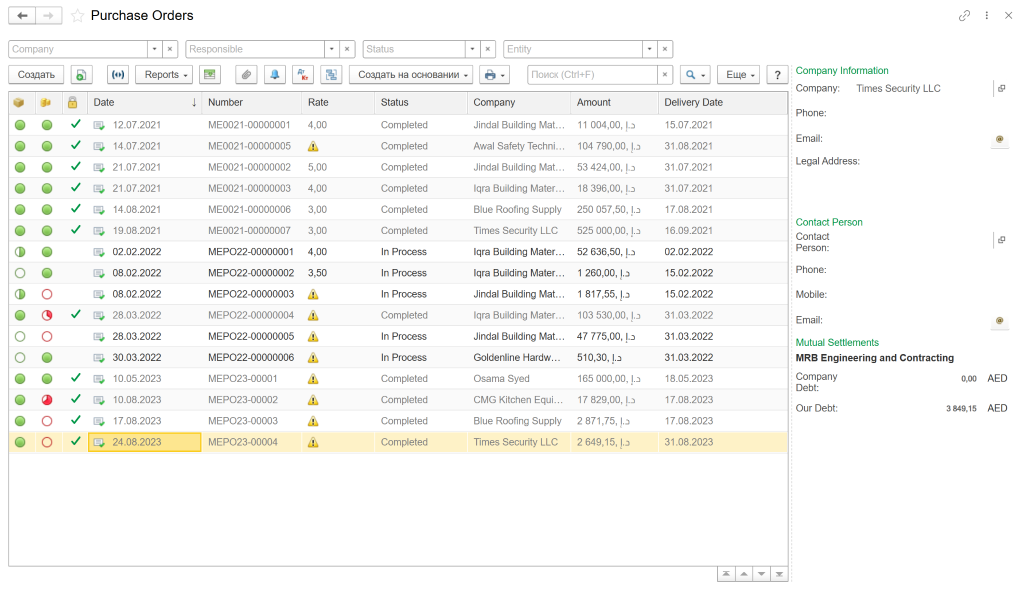
Procurement and purchase order management in FirstBit ERP
5 Key Factors That Shape the Final ERP Implementation Cost
The final cost is influenced not only by company size but also by several other parameters:
-
Number of active projects and their complexity
-
Need for integration with external systems (banks, HR, BIM)
-
Level of customization and adaptation to business processes
-
Localization requirements and compliance with KSA laws
-
Implementation model: cloud or on-premise infrastructure
Each of these factors can significantly impact the budget. For example, integrations and customization often account for up to 40% of the total project cost.
It is important to assess all requirements in advance and choose solutions that match the industry and engineering specifics. This helps avoid overspending and ensures effective system usage.
In this context, systems like FirstBit ERP Contracting can help control implementation costs through a modular structure and built-in, construction-specific functionality. This approach reduces the need for extensive customization and makes managing implementation easier as requirements grow.
Localization as the Main Cost Component: ZATCA, Taxes, and Labor Law in KSA
One of the key aspects of ERP implementation in Saudi Arabia is the need for full system localization.
Companies must comply with ZATCA requirements, including e-invoicing, digital data exchange, and strict reporting standards. Compliance with tax rules and labor legislation is also essential, particularly in payroll calculation and time tracking.
This means that standard international solutions are not always suitable without modification. Systems must be adapted to the local market and regulatory requirements.
That is why choosing the right vendor plays a critical role. For example, First Bit offers construction software tailored to regional specifics, including VAT, withholding tax, and payroll-related calculations, as well as integration with ZATCA e-invoicing requirements. This helps businesses meet local regulatory requirements while streamlining financial operations.
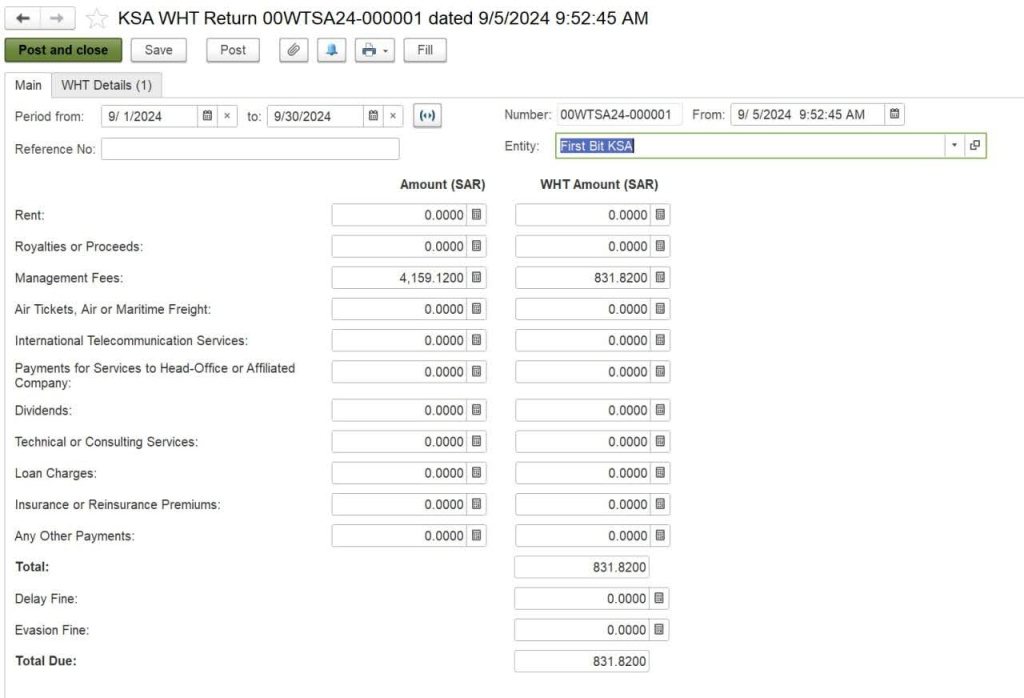
Withholding tax return declaration in FirstBit ERP Contracting
You can explore the solutions here: https://firstbit.sa/en/
Such systems not only ensure compliance but also enable efficient management of contracts, resources, and financial flows, helping companies remain competitive in the market.
How to Get an Accurate Budget Estim
Despite approximate ranges, the exact budget is always individual. It depends on business goals, number of users, project complexity, and system architecture.
To get the most accurate estimate, it is important to go through a system demonstration and discuss requirements with experts. This helps determine which functionality is truly needed, which tools will be used, and how to optimize costs.
FirstBit ERP Contracting provides the opportunity to explore solutions, select the optimal configuration, and receive a commercial proposal after a demo. Learn more here: https://firstbit.sa/en/
A properly calculated ERP budget is the foundation of successful digital transformation. It helps not only implement the system but also make project management transparent, controlled, and efficient at every stage.

Editorial
First Bit Team
Share this article
'%3e%3cg%20clip-path='url(%23clip1_6548_6055)'%3e%3cpath%20d='M13.974%2015.6195C14.2724%2016.0185%2014.6532%2016.3487%2015.0905%2016.5876C15.5278%2016.8265%2016.0114%2016.9686%2016.5084%2017.0042C17.0055%2017.0398%2017.5043%2016.9681%2017.9712%2016.7939C18.4381%2016.6198%2018.8621%2016.3472%2019.2143%2015.9948L21.2994%2013.9098C21.9324%2013.2544%2022.2827%2012.3766%2022.2747%2011.4654C22.2668%2010.5543%2021.9014%209.68269%2021.257%209.03839C20.6127%208.39408%2019.7412%208.02862%2018.83%208.0207C17.9189%208.01278%2017.0411%208.36305%2016.3857%208.99606L15.1902%2010.1845M16.754%2014.2295C16.4555%2013.8305%2016.0747%2013.5003%2015.6374%2013.2614C15.2002%2013.0225%2014.7166%2012.8804%2014.2196%2012.8448C13.7225%2012.8092%2013.2237%2012.8809%2012.7568%2013.0551C12.2899%2013.2292%2011.8659%2013.5018%2011.5136%2013.8542L9.42861%2015.9392C8.7956%2016.5946%208.44534%2017.4724%208.45326%2018.3836C8.46117%2019.2947%208.82664%2020.1663%209.47094%2020.8106C10.1152%2021.4549%2010.9868%2021.8204%2011.898%2021.8283C12.8091%2021.8362%2013.6869%2021.4859%2014.3423%2020.8529L15.5308%2019.6645'%20stroke='%235F7896'%20stroke-width='1.39002'%20stroke-linecap='round'%20stroke-linejoin='round'/%3e%3c/g%3e%3c/g%3e%3crect%20x='0.438953'%20y='0.438953'%20width='28.9709'%20height='28.9709'%20rx='14.4855'%20stroke='%235F7896'%20stroke-width='0.877907'/%3e%3cdefs%3e%3cclipPath%20id='clip0_6548_6055'%3e%3crect%20width='29.8488'%20height='29.8488'%20rx='14.9244'%20fill='white'/%3e%3c/clipPath%3e%3cclipPath%20id='clip1_6548_6055'%3e%3crect%20width='16.6802'%20height='16.6802'%20fill='white'%20transform='translate(7.02344%206.58435)'/%3e%3c/clipPath%3e%3c/defs%3e%3c/svg%3e)


Related articles


See all




See FirstBit ERP solutions in action
Discover how our system solves the unique challenges of contractors in a personalized demo.
After the demo you will get a quotation for your company.