Many construction projects start with a defined budget but still face cost growth, margin pressure, and repeated revisions during execution. In most cases, the issue begins long before construction starts, with weak construction cost estimating and cost control practices, incomplete scope reviews, and limited visibility into real project costs.
This is a major issue in cost estimation in construction projects. One study found that cost overruns reach 20% in road projects and 90% in transportation infrastructure projects[?].
The good news is that this problem can be managed. With stronger estimating methods, better cost control practices, and the right approach to how to estimate construction costs, teams can reduce risk and improve financial decisions.
In this article, we explain how construction cost estimating and cost control work together, review key cost estimation techniques in construction projects, and show how to build a more reliable cost process.
Construction Cost Estimating and Cost Control: How They Are Connected
Construction cost estimating and cost control are closely connected. Estimating sets the project budget before construction starts. Cost control tracks spending during execution and helps keep the project within the budget.
A reliable estimate is the starting point for cost management. It defines:
-
Labor
-
Materials
-
Equipment
-
Permits
-
Overhead
It also supports bidding, planning, and early project decisions. The accuracy of this step depends on the quality of drawings, specifications, quantities, and pricing data.
Cost control begins once the budget is approved. It focuses on:
This helps teams respond to delays, price changes, and other issues before they affect the full project budget. Early visibility allows project managers to adjust procurement plans, labor allocation, or scheduling decisions before small cost variations become major overruns.
Estimating establishes the budget baseline, and cost control manages actual spending against it throughout execution. The quality of cost control depends on the quality of the original estimate. In the same way, even a well-prepared estimate loses value when costs are not monitored and managed consistently during the project.
Together, construction cost estimating and cost control create a continuous financial management process. This approach helps teams make better commercial decisions from preconstruction planning through project completion.
Cost Estimation Techniques in Construction Projects
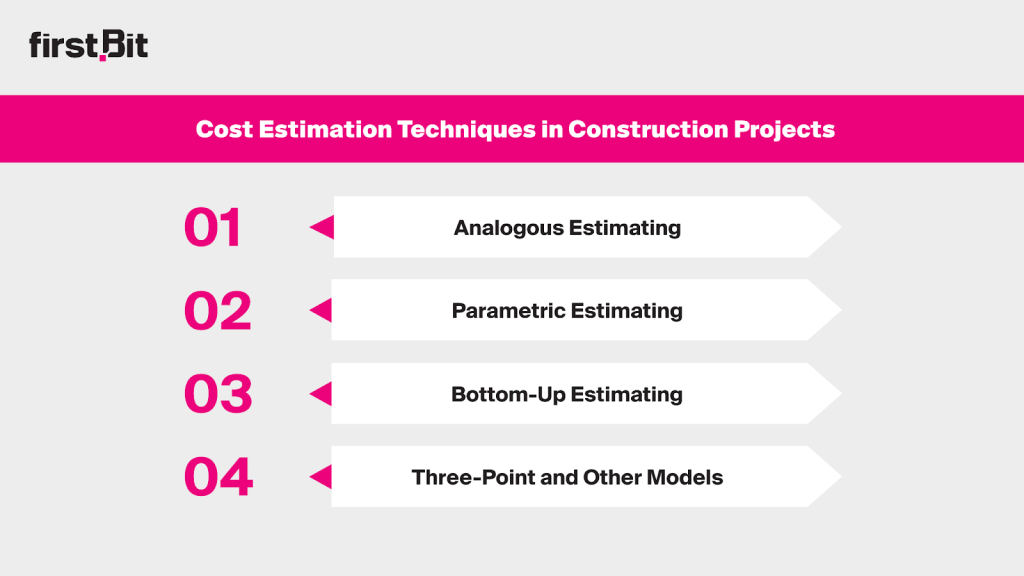
Different approaches are used for cost estimation in construction projects depending on the level of design detail, required accuracy, available time, and the quality of historical data. The right method depends on the level of design detail, the required accuracy, the available time, and the quality of historical data.
Cost Estimation Techniques in Construction Projects
Analogous Estimating
Analogous estimating uses cost data from similar completed projects to prepare an early estimate for a new one. It is used when the scope is still limited, and the team needs a fast budget range for early planning.
Choose a truly comparable project and adjust the numbers for size, location, quality level, market conditions, and key scope differences. If the reference project is weak or poorly matched, the estimate will be misleading from the start.
Parametric Estimating
Parametric estimating uses measurable project variables to calculate cost. These variables may include floor area, number of units, project duration, or building type. It gives a more structured estimate than a simple comparison.
Define the right cost drivers first and make sure the data behind them is current and reliable. If the model is built on weak inputs or generic assumptions, the estimate may look precise but still produce the wrong budget.
Bottom-Up Estimating
Bottom-up estimating builds the total project cost from detailed work items or work packages and is commonly used by a construction cost estimator when preparing detailed bids. Each part of the scope is measured and priced separately, then combined into the full estimate. This is the most detailed estimating method.
Break the project into clear packages, measure quantities carefully, and price labor, materials, equipment, subcontract work, and indirect costs in a consistent format. If quantities are missed or scope is duplicated, those errors move directly into the bid and later turn into overruns, disputes, or rework.
Three-Point and Other Models
Three-point estimating is used when the estimate includes a high level of uncertainty. Instead of using one fixed number, it builds three cost scenarios: optimistic, most likely, and pessimistic. This gives a more realistic view of possible cost outcomes.
Apply this method to uncertain packages, unstable pricing, evolving design, or difficult site conditions. Use it to set contingency more accurately and test cost exposure before final pricing. If uncertain items are treated as fixed and fully defined, the estimate can fail during execution.
In practice, project teams often combine multiple cost estimation techniques in construction projects to improve estimate reliability. Early planning may use analogous or parametric methods, while detailed project budgeting relies more on bottom-up estimating and scenario analysis.
How to Estimate Construction Costs
A reliable construction cost estimate depends on a structured process that improves accuracy, supports pricing decisions, and creates a stronger basis for cost control. Understanding how to estimate construction costs properly helps project teams prepare realistic budgets and reduce financial risk before construction begins.
Project Documentation Review
Start with the full set of bid and contract documents. Review drawings, specifications, general conditions, supplementary conditions, bond forms, and owner-contractor agreements before pricing any item.
Check that the document set is complete and that the scope is clearly defined. Review architectural, structural, MEP, and site information to identify material needs, construction methods, quality requirements, and unusual project features. A construction cost estimator uses this information to understand the full project scope before quantities are measured or prices are assigned.
Break the work into clear scopes or work packages to avoid gaps, overlaps, and duplicated pricing. Add a site visit where needed to confirm access, utilities, drainage, soil conditions, and local restrictions that may affect cost.
Quantity Take-Off and Bill of Quantities Preparation
Once the scope is clear, perform the quantity take-off. Measure and
list the materials, labor, and equipment required for each part of the work. Organize quantities by count, area, volume, or length, depending on the trade and item.
Use the take-off to build the pricing structure and budget logic. If a bill of quantities is provided, verify it against the drawings and specifications instead of using it without review. Check for missing items, incorrect quantities, and scope differences. Errors at this stage weaken the full estimate and create problems later in procurement, bidding, and cost control.
Pricing Inputs
After quantities are confirmed, assign prices to each item. Use current rates for materials, labor, equipment, and subcontractor work. Base pricing on realistic assumptions about productivity, procurement timing, and project duration.
Include waste, order size, quote validity, and supply conditions in material pricing. Use loaded labor rates that include wages, taxes, insurance, leave, and benefits. Include ownership, rental, lease, maintenance, fuel, and depreciation in equipment pricing where relevant.
For projects in Saudi Arabia, pricing inputs must reflect local KSA market conditions. This includes labor availability, supplier capacity, logistics constraints, permit requirements, and current trade pricing. Ignoring these local factors can quickly lead to inaccurate project budgets.
Calculating Indirect and Overhead Costs
Add indirect costs and overhead after direct costs are priced. These cost categories should be identified early and not left as minor adjustments at the end of the estimate. If they are overlooked, the project budget may appear accurate but fail to reflect the real cost of delivery.
Indirect costs typically include permits, temporary site facilities, cleaning, utilities, professional services, software, project-specific management, insurance, and bonds. Overhead costs include office rent, administrative salaries, subscriptions, utilities, taxes, and corporate insurance. These costs should be allocated using a clear internal method so they are properly reflected in the overall estimate.
When indirect costs and overhead are missed or understated, the estimate can underestimate the true cost of completing the project. This often leads to margin pressure and financial adjustments later during execution.
Contingency and Profit
Apply contingency and profit after the cost structure is complete. Set contingency according to project risk, design maturity, market conditions, and the quality of available information. Set profit according to company targets, competition level, and project complexity.
Do not apply standard percentages without review. A weak contingency allowance leaves the estimate exposed to normal cost variation. A weak profit allowance may produce a bid that wins work but performs poorly. Both items should be based on project conditions, not habit.
Verification and Peer Review
Review the estimate before final submission. Check scope coverage, quantity logic, price inputs, indirect cost allocation, assumptions, and markup structure. Confirm that the estimate matches the drawings, specifications, and contract requirements.
Use peer review to test the estimate before it becomes a bid or budget. A second estimator, project manager, or commercial lead should review the estimate with the construction cost estimator to check for missing scope, double-counting, pricing errors, and weak assumptions. This step improves estimate quality and reduces the risk of cost problems during execution.
Best Practices for Construction Cost Estimating and Cost Control
The following practices help improve estimate quality and strengthen cost control across the project lifecycle.
Best Practices for Construction Cost Estimating and Cost Control
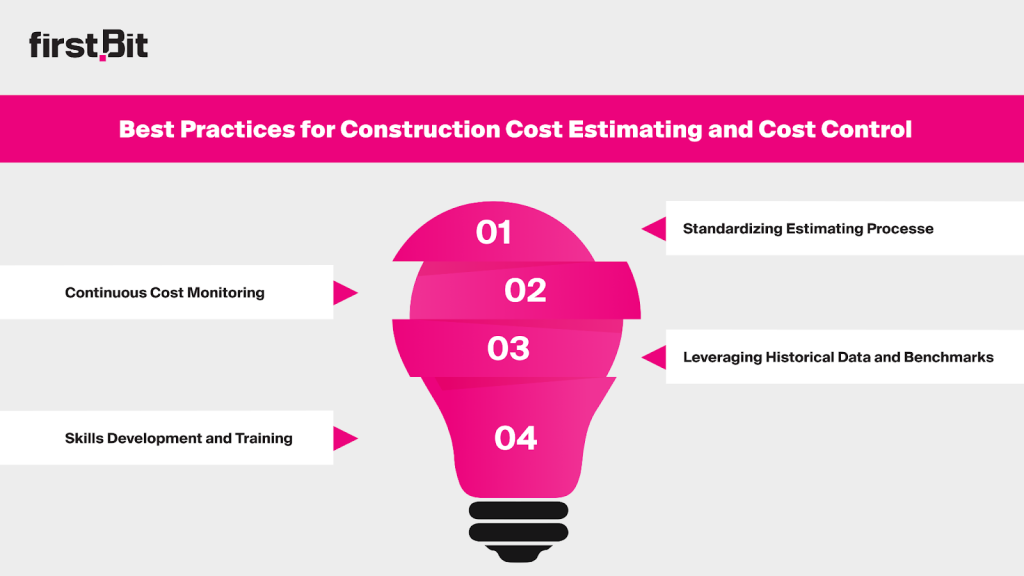
Standardizing Estimating Processes
Use common templates, coding structures, work breakdown systems, and pricing rules across projects. This makes estimates easier to prepare, review, compare, and update. It also reduces the risk of missed scope and improves coordination between estimating, procurement, and project controls.
A consistent format becomes even more important when estimates move into budgets, bid submissions, schedules of values, and reporting systems. Many companies support this process using construction cost estimating software, which standardizes estimate formats and connects estimating data with procurement and project accounting systems.
Continuous Cost Monitoring
Keep cost control active after the estimate is approved. Track actual costs, committed costs, change orders, and forecast updates on a regular basis. This helps teams identify deviations early and respond before they affect the full project budget.
Regular reporting and real-time visibility support better decisions on procurement timing, labor use, subcontract performance, and contingency management. Many companies now rely on construction cost estimating software to connect the original estimate with live project cost data during execution.
Cost monitoring works best when the original estimate is detailed enough to serve as a clear control baseline. This baseline allows teams to compare planned budgets with actual spending throughout the project lifecycle.
Leveraging Historical Data and Benchmarks
Use historical cost data to support both new estimates and ongoing cost control. Past project records can improve pricing decisions, productivity assumptions, waste allowances, equipment planning, subcontractor benchmarking, and indirect cost allocation.
Benchmarks also help test whether current estimates are aligned with similar projects, market conditions, or internal cost targets. When this information is stored in construction cost estimating software, estimators can analyze historical cost estimation in construction projects more accurately. Over time, this creates a stronger basis for forecasting and commercial planning.
Skills Development and Training
Treat estimating and cost control as skills that need continuous development. Even with strong software and templates, results still depend on the judgment of estimators and project leaders. Teams need a working knowledge of construction methods, productivity, pricing logic, contract requirements, and risk allocation.
Training should also cover digital tools, data handling, and post-project cost review. Companies that invest in these areas usually build more reliable estimating processes and stronger cost control practices.
Why FirstBit ERP Is the Best Cost Estimating Software for KSA
For construction companies in Saudi Arabia, cost estimating software needs to improve estimate accuracy, support cost control, and give teams better visibility into project financials as conditions change. This is where
FirstBit ERP brings practical value.
FirstBit ERP connects estimating with real project costs. Many cost problems start when the estimate is prepared in one place and actual spending is tracked somewhere else. That disconnect makes it harder to compare the original budget with procurement, subcontractor commitments, and live project costs.
The system helps close that gap by linking estimating with project budgeting, purchasing, and cost tracking in one environment. This makes it easier to spot deviations early and take action before they affect the full project budget.
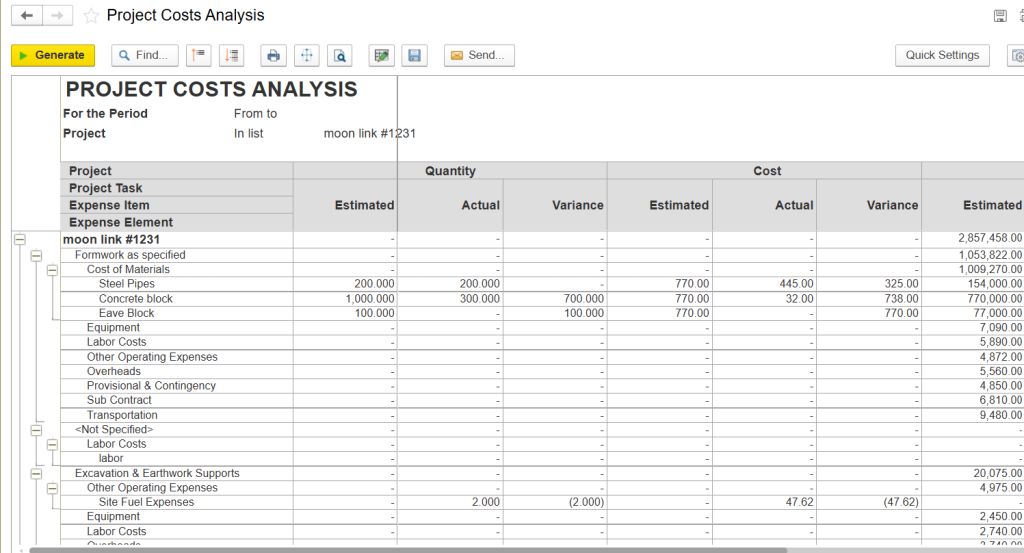
Project Cost Analysis in FirstBit ERP
The system gives you better control over indirect costs and margins. Direct costs are only part of the estimate. Site overhead, insurance, permits, temporary facilities, corporate overhead, and margin assumptions also need to be captured and monitored properly.
The ERP system helps teams track these cost layers more consistently and see how they affect project profitability over time. This is important in projects where margins can weaken quickly if indirect costs are understated or not monitored closely after award.
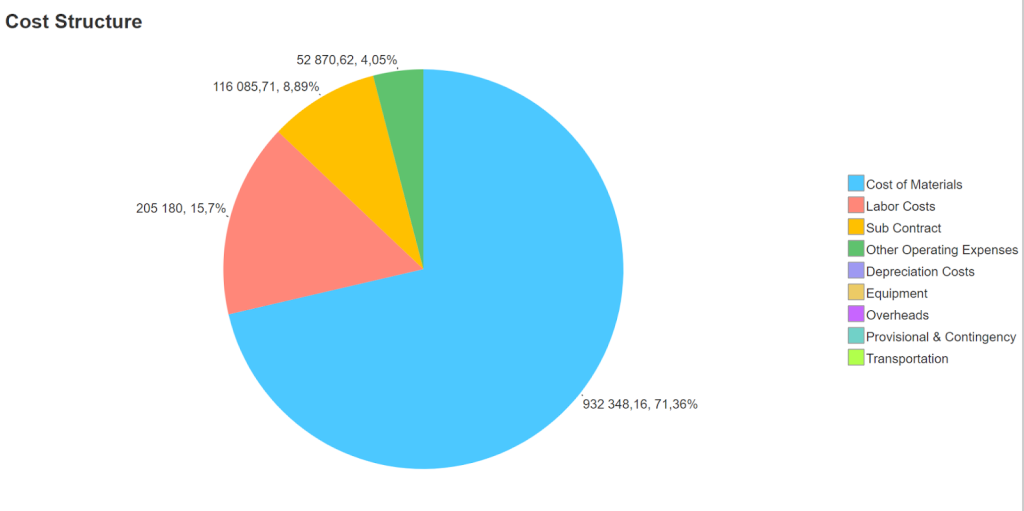
Cost Structure Diagram in FirstBit ERP
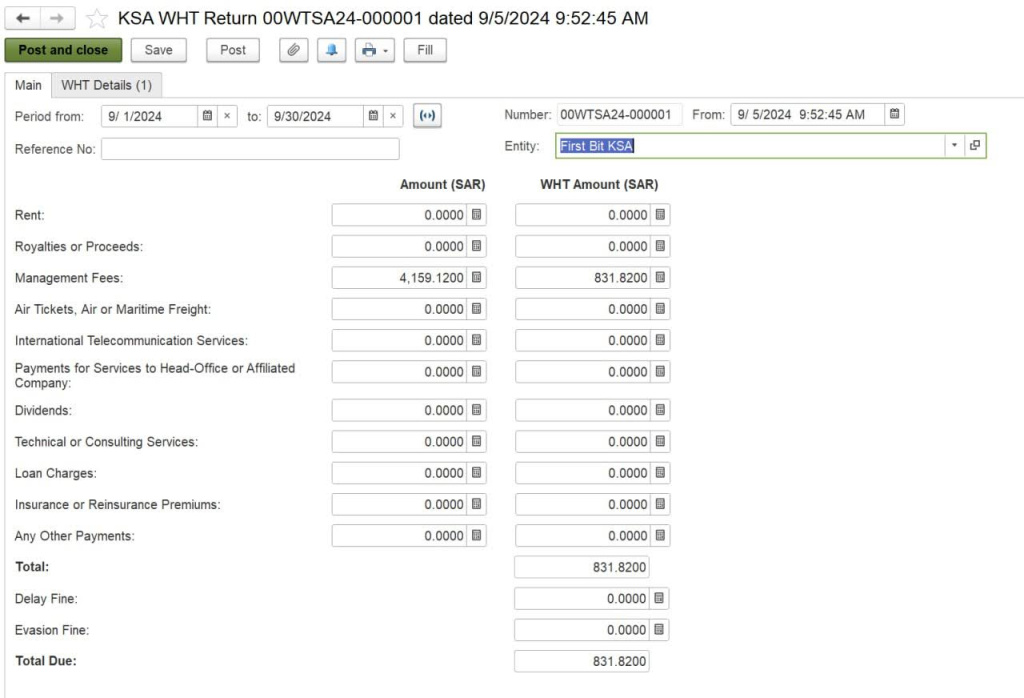
FirstBit ERP supports compliance with KSA regulatory and reporting requirements. Construction companies in Saudi Arabia need accurate financial and project records for tax processes, formal reporting, and external documentation.
FirstBit ERP helps structure this data in one system and generate the required reports without manual preparation in separate files. This reduces reporting errors, saves time, and makes compliance processes more controlled and consistent.
KSA Withholding Tax Return Tab in FirstBit ERP
Conclusion
Most cost overruns do not start in the field. They start earlier, when weak estimates, incomplete inputs, and poor cost visibility are treated as minor issues. By the time the problem appears in the budget, the real cause is often already built into the project.
Most cost overruns do not start in the field. They start earlier, when weak estimates, incomplete inputs, and poor cost visibility are treated as minor issues. By the time the problem appears in the budget, the real cause is often already built into the project. That is why construction cost estimating and cost control should be treated as one process. Strong cost performance depends less on one accurate number and more on how well the project team builds, checks, and updates the cost baseline over time.
F.A.Q.
What is construction cost estimating and why is it critical in Saudi Arabia?
Construction cost estimating is the process of forecasting the total cost of a building project before it begins. In Saudi Arabia, accurate estimating is essential due to Vision 2030 mega-projects, strict ZATCA compliance, volatile material prices, and complex labor regulations all of which directly impact project profitability.
How can ERP software improve construction cost estimating and control?
Modern ERP systems like FirstBit ERP automate BOQ processing, link estimates to live procurement data, track actual vs. budgeted costs, and enable scenario-based forecasting, reducing human error, preventing budget overruns, and ensuring compliance with local financial standards.
How do you control construction costs after the estimate is approved?
Cost control starts with real-time tracking of expenses against the baseline estimate. ERP tools help by monitoring procurement, payroll, equipment usage, and progress billing, enabling proactive adjustments if actual costs deviate from the plan.
Can a construction cost estimator in Saudi Arabia work without specialized software?
While possible for small projects, manual estimating is risky in Saudi Arabia’s fast-paced, regulation-heavy environment. Software reduces errors, ensures audit readiness, and supports scalable bidding, especially critical for contractors bidding on government or Vision 2030–linked tenders.













'%3e%3cg%20clip-path='url(%23clip1_6548_6055)'%3e%3cpath%20d='M13.974%2015.6195C14.2724%2016.0185%2014.6532%2016.3487%2015.0905%2016.5876C15.5278%2016.8265%2016.0114%2016.9686%2016.5084%2017.0042C17.0055%2017.0398%2017.5043%2016.9681%2017.9712%2016.7939C18.4381%2016.6198%2018.8621%2016.3472%2019.2143%2015.9948L21.2994%2013.9098C21.9324%2013.2544%2022.2827%2012.3766%2022.2747%2011.4654C22.2668%2010.5543%2021.9014%209.68269%2021.257%209.03839C20.6127%208.39408%2019.7412%208.02862%2018.83%208.0207C17.9189%208.01278%2017.0411%208.36305%2016.3857%208.99606L15.1902%2010.1845M16.754%2014.2295C16.4555%2013.8305%2016.0747%2013.5003%2015.6374%2013.2614C15.2002%2013.0225%2014.7166%2012.8804%2014.2196%2012.8448C13.7225%2012.8092%2013.2237%2012.8809%2012.7568%2013.0551C12.2899%2013.2292%2011.8659%2013.5018%2011.5136%2013.8542L9.42861%2015.9392C8.7956%2016.5946%208.44534%2017.4724%208.45326%2018.3836C8.46117%2019.2947%208.82664%2020.1663%209.47094%2020.8106C10.1152%2021.4549%2010.9868%2021.8204%2011.898%2021.8283C12.8091%2021.8362%2013.6869%2021.4859%2014.3423%2020.8529L15.5308%2019.6645'%20stroke='%235F7896'%20stroke-width='1.39002'%20stroke-linecap='round'%20stroke-linejoin='round'/%3e%3c/g%3e%3c/g%3e%3crect%20x='0.438953'%20y='0.438953'%20width='28.9709'%20height='28.9709'%20rx='14.4855'%20stroke='%235F7896'%20stroke-width='0.877907'/%3e%3cdefs%3e%3cclipPath%20id='clip0_6548_6055'%3e%3crect%20width='29.8488'%20height='29.8488'%20rx='14.9244'%20fill='white'/%3e%3c/clipPath%3e%3cclipPath%20id='clip1_6548_6055'%3e%3crect%20width='16.6802'%20height='16.6802'%20fill='white'%20transform='translate(7.02344%206.58435)'/%3e%3c/clipPath%3e%3c/defs%3e%3c/svg%3e)