Knowing how to track project progress is no longer optional for construction contractors in Saudi Arabia. Projects are larger, schedules are tighter, and stakeholders expect clear evidence of progress at every stage. Without structured tracking, small delays can quickly turn into major commercial risks.
Many contractors still rely on outdated systems, such as fragmented updates and spreadsheets, or delayed site reports. These methods make it difficult to understand the real status of work or explain deviations to clients and investors. This is where disciplined tracking and reporting project progress becomes a control mechanism, not an administrative task.
A global study by McKinsey found that 98% of large construction projects experience cost overruns or delays, often linked to weak project controls and poor progress visibility [?] .
This article explains how to track progress of a project in construction using practical, repeatable steps. It focuses on methods and tools to track project progress that support informed decisions, accurate reporting, and predictable delivery across KSA construction projects.
Importance of Tracking and Reporting Project Progress
Tracking and reporting project progress creates visibility across schedule, cost, and execution. For KSA contractors, this visibility is critical when managing multiple work packages, subcontractors, and milestone-based payments.
When teams understand how to track project progress, they can identify slippage early and act before delays escalate. Timely insight supports better sequencing decisions, resource adjustments, and risk mitigation on active sites.
PMI’s global research shows that high-performing organizations meet original project goals 2.5× more often than low performers (90% vs 36%). Strong monitoring and progress visibility are core contributors to this performance gap [?] .
Clear tracking and reporting project progress also protects commercial outcomes. It provides documented evidence to support valuations, variations, and certifications, reducing disputes and strengthening stakeholder confidence.
How to Track Project Progress
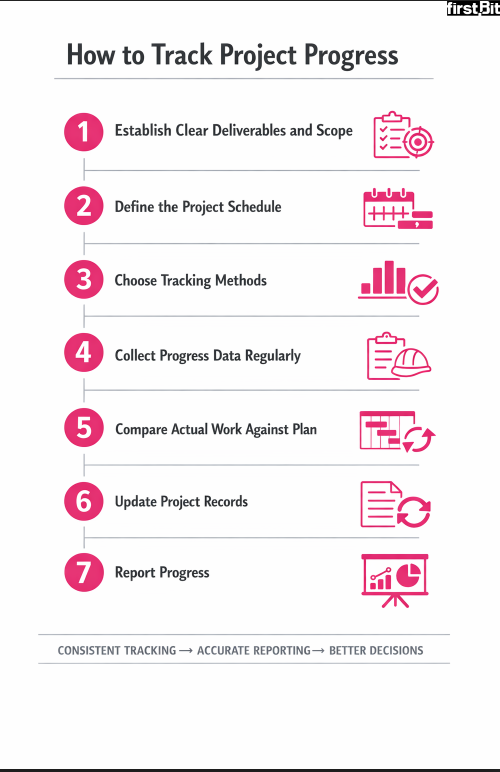
To understand how to track project progress, contractors need a structured process that connects site activity with schedule and commercial baselines. Progress tracking should reflect physical work completed on site, not intentions or internal estimates. Without this structure, reporting becomes subjective and difficult to rely on.
A step-by-step approach creates consistency across teams and projects. It ensures that progress data is collected, validated, and reported in the same way throughout the project lifecycle. This consistency is what makes tracking and reporting project progress useful for decision-making rather than retrospective analysis.
1. Establish Clear Deliverables and Scope
Before work begins, define all tasks, work packages, and expected outputs in measurable terms. Each deliverable should have a clear completion criterion so teams know exactly when work can be reported as finished. This removes ambiguity and prevents inflated progress claims.
Clear scope alignment also helps teams understand how individual tasks contribute to overall project objectives. When everyone shares the same definition of success, it becomes easier to agree on progress status. This clarity is foundational for how to keep track of project progress without conflict.
2. Define the Project Schedule
Develop a detailed project schedule that includes start and end dates for every task and milestone. The schedule should reflect realistic site conditions, procurement timelines, and approval cycles, not ideal assumptions. A credible baseline is essential for understanding whether work is progressing as planned.
Logical dependencies must be built into the schedule so teams can see how activities interact. When one task slips, the impact on downstream work becomes visible immediately. This structure is critical for how to track progress of a project accurately and consistently.
3. Choose Tracking Methods
Decide upfront how progress will be measured across the project. Common approaches include percent completed by task, visual progress versus plan, or comparison of actual and planned dates. The method should match the level of detail and control required.
Consistency matters more than complexity. Using the same tracking method across all teams ensures data remains comparable and trustworthy. This consistency strengthens tracking and reporting project progress at both the site and management levels.
4. Collect Progress Data Regularly
Progress data should be collected on a daily or weekly basis through site observations, field logs, or digital reports. Frequent updates reduce reliance on memory and help capture issues while they are still manageable. Irregular data collection often leads to distorted progress reporting.
Centralizing data collection improves accuracy and efficiency. When all updates feed into one system, teams gain a single source of truth. This approach supports reliable tools to track project progress across multiple sites and stakeholders.
5. Compare Actual Work Against Plan
Once data is collected, compare actual progress against the baseline schedule. This step reveals time and sequencing variances that may not be obvious during daily site activity. Early visibility allows corrective action before delays become critical.
Simple tools such as updated Gantt charts or earned value indicators help quantify deviation. These comparisons move progress tracking from observation to analysis. They are central to how to track project progress in a controlled way.
6. Update Project Records
Project records must be updated continuously to reflect actual dates, completed quantities, and remaining work. When schedules are not updated, progress reports quickly lose credibility and stop supporting decision-making. Accurate records are essential for reliable project control.
Keeping the master plan current ensures all stakeholders are working from the same information. It eliminates parallel versions of the truth and reduces disputes over progress status. This discipline underpins effective tracking and reporting project progress.
7. Report Progress
Progress reports should translate site data into clear, actionable insight for each audience. Project teams need operational detail, while clients and management require summarized status, risks, and corrective actions. Reports should focus on clarity, not volume.
Consistent reporting closes the loop between tracking and control. It ensures that progress data leads to decisions and follow-up actions. This is the final step in how to keep track of project progress in a meaningful way.
Best Practices for Tracking Progress of a Project
Effective progress tracking depends on disciplined execution, not just on having a process in place. Best practices ensure that progress data reflects what is physically happening on site and not assumptions or optimistic estimates. This distinction is critical when progress data is later used for forecasting, certifications, or commercial decisions.
For contractors operating in Saudi Arabia, these practices help manage complexity across large sites and multiple subcontractors. They reduce ambiguity in reporting and create a consistent way of tracking and reporting project progress that management and external stakeholders can trust over time.
The World Economic Forum notes that construction projects commonly face major schedule slippage, with delivery often extending well beyond the original plan due to coordination and performance-management gaps. This is one reason progress visibility and structured reporting matter from early execution stages [?] .
Centralize Progress Data
Progress data should be collected and stored in one centralized system rather than spread across spreadsheets, emails, and messaging tools. Fragmentation makes it difficult to verify information and often results in delays or conflicting progress figures. Over time, this undermines confidence in reports.
Centralization creates a single source of truth for the project. It allows teams to compare actual performance against plan consistently and supports reliable how to track project progress across phases and reporting periods.
Use Regular Field Observations
Regular field observations are essential for validating reported progress against actual site conditions. Site walks, photos, and documented checks provide objective evidence that work claimed as complete has been executed as planned. This reduces reliance on assumptions or second-hand updates.
When field observations are captured consistently and linked to scheduled activities, progress reporting becomes more credible. Visual confirmation adds context to numbers and strengthens confidence in how to track project progress on active construction sites.
Maintain Clear Task Ownership
Each tracked task or work package should have one clearly defined owner responsible for updating its progress. Without clear ownership, reporting becomes inconsistent, and issues remain unresolved longer than necessary. Accountability is a prerequisite for reliable progress tracking.
Clear task ownership also improves communication across contractors and subcontractors. It ensures progress updates are timely and supports how to keep track of project progress when multiple parties are involved.
Standardize Data Entry
Progress data should be captured using standardized formats such as templates, forms, or structured digital inputs. Inconsistent data entry makes aggregation and comparison difficult, especially on large or multi-site projects. Over time, this leads to reporting errors and rework.
Standardization ensures that progress data can be analyzed and reported consistently. It enables scalable tracking and reporting project progress without increasing administrative effort.
Tools to Track Project Progress
The tools used to track project progress directly affect how accurately site activity is reflected in reports. In construction projects, tools must support structured data capture, comparison against the plan, and clear communication across teams. Choosing the right tools helps ensure that progress data is reliable rather than fragmented.
Different tools serve different control objectives, from schedule monitoring to real-time visibility. Understanding how each tool contributes makes it easier to decide how to track project progress consistently throughout the project lifecycle.
Gantt Charts and Scheduling Tools
Gantt charts provide a structured visual representation of planned and actual progress over time. They show task durations, dependencies, and percent complete, making it easier to identify sequencing issues and schedule slippage. This visibility is essential for understanding how delays propagate across activities.
For contractors learning how to track progress of a project, scheduling tools form the baseline for all progress comparisons. They support early detection of deviations and enable informed decisions before delays affect critical milestones.
Dashboards and Real-Time Analytics
Dashboards consolidate progress, cost, and risk indicators into a single, accessible view. Instead of reviewing multiple reports, project managers can quickly assess overall status and focus on areas requiring attention. This improves situational awareness across complex projects.
Real-time analytics strengthen tracking and reporting project progress by highlighting deviations as they occur. Early visibility allows teams to respond faster and reduce the impact of emerging risks on delivery outcomes.
Field Reporting Tools
Field reporting tools allow site teams to capture progress updates directly from the jobsite. Mobile access reduces delays between work completion and reporting, improving the timeliness of progress data. This is especially important on large or fast-moving sites.
Consistent field inputs improve accuracy and transparency. They play a key role in how to keep track of project progress when multiple crews and subcontractors are working simultaneously.
Integrations (BIM, Drones, IoT)
Advanced integrations connect physical progress with digital representations of the project. BIM models, drone imagery, and sensor data provide objective evidence of work completed, reducing reliance on manual estimates. This improves confidence in reported progress.
These integrations are particularly valuable on complex or remote projects. They support a more precise way to track project progress by linking virtual reality with planned schedules and quantities.
How to Track Project Progress With FirstBit ERP
FirstBit ERP is a comprehensive enterprise resource planning platform designed for construction companies. It integrates project execution, finance, procurement, and reporting into a unified system, enabling consistent and auditable project progress tracking.
Key capabilities that support tracking and reporting project progress within
FirstBit ERP include:
Structured project and work package tracking. Projects are organized into defined activities, work packages, or milestones, allowing progress to be measured against planned scope and quantities rather than informal task completion.
Centralized progress data management. Progress updates, actual dates, and completion percentages are recorded in a single system, reducing reliance on spreadsheets and ensuring a consistent source of project status information.
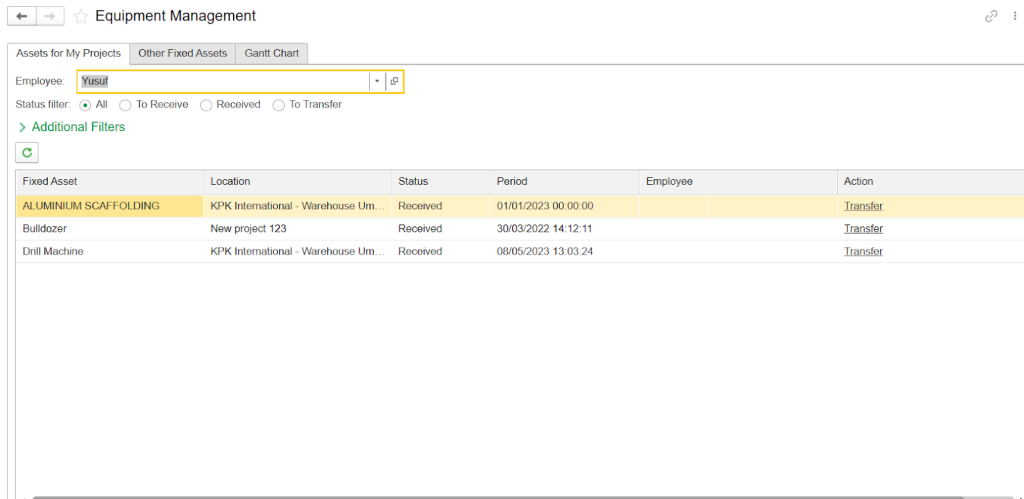
Equipment management in FirstBit ERP
Linkage between progress, schedule, and cost. Recorded progress is connected to project schedules and financial data, helping teams understand how execution status affects timelines, budgets, and forecasts.
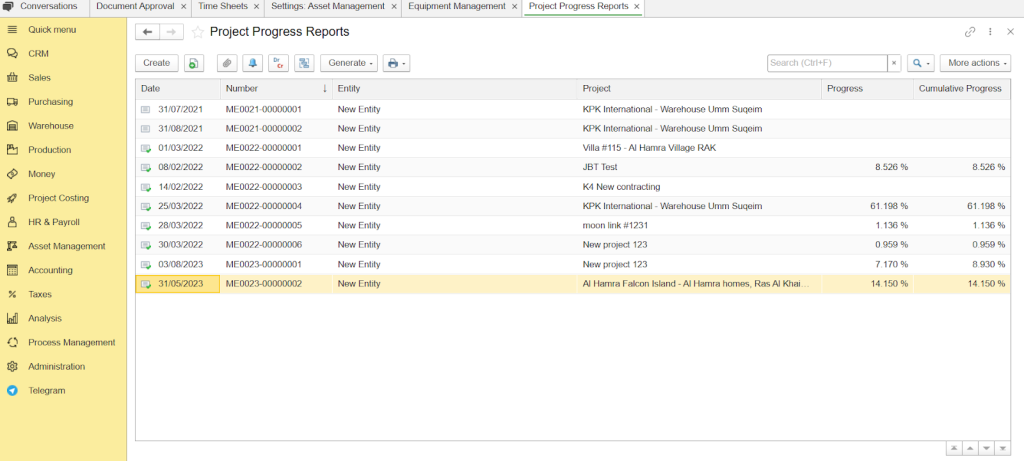
Standardized progress reporting. Progress reports are generated from live project data, providing clear visibility into completed work, remaining activities, and deviations from plan without manual consolidation.
Project progress report in FirstBit ERP
Cross-functional integration with finance and procurement. Because progress data sits within an ERP environment, it aligns with cost control, procurement status, and payment processes, supporting broader project governance and control.
By embedding progress tracking within core operational workflows,
FirstBit ERP supports a more structured and auditable approach to project control. It allows contractors to track progress using consistent data that connects execution, schedule, and financial impact. This integration helps reduce reporting gaps and supports clearer decision-making throughout the project lifecycle.
Conclusion
Tracking project progress in construction is ultimately about maintaining control in an environment defined by complexity and change. For contractors in Saudi Arabia, effective progress tracking supports timely decisions, transparent reporting, and stronger alignment between execution and commercial outcomes.
A structured approach supported by clear scope definitions, consistent data collection, and reliable reporting reduces uncertainty across the project lifecycle. When progress data reflects reality on site, teams can respond earlier to risks and maintain confidence with clients and stakeholders.
As delivery expectations continue to rise across the KSA construction sector, the ability to track, analyze, and report progress accurately will remain a defining capability. Contractors that treat progress tracking as a core management discipline, rather than an administrative task, are better positioned to deliver predictable and resilient project outcomes.
FAQ
Why is tracking project progress more challenging for construction projects in Saudi Arabia specifically?
Construction projects in Saudi Arabia often span large geographic areas and involve complex logistics. Multiple subcontractors, remote sites, and fast-tracked delivery models increase coordination risk. In addition, higher reporting expectations from clients and authorities require progress data to be accurate, timely, and well-documented.
What’s the difference between tracking tasks and truly tracking project progress?
Task tracking focuses on whether individual activities are marked complete. True project progress tracking connects execution status with schedule impact, cost exposure, and remaining work. It answers not just what is done, but whether the project is still on track to meet its overall objectives.
How often should progress reports be generated, and what should they include for stakeholders in KSA projects?
Operational teams typically need daily or weekly progress visibility to manage site execution. Clients and senior stakeholders usually require structured summary reports on a weekly or monthly basis. These reports should clearly show completed work, upcoming activities, key risks, and any corrective actions underway.
Umme Aimon Shabbir
Editor at First Bit
Aimon brings a deep understanding of the modern construction business to her articles. Her strength is providing practical content that enhances users’ understanding and usage of the software in the industry. As an editor, Aimon helps our authors reach their full potential and produce their best work.










'%3e%3cg%20clip-path='url(%23clip1_6548_6055)'%3e%3cpath%20d='M13.974%2015.6195C14.2724%2016.0185%2014.6532%2016.3487%2015.0905%2016.5876C15.5278%2016.8265%2016.0114%2016.9686%2016.5084%2017.0042C17.0055%2017.0398%2017.5043%2016.9681%2017.9712%2016.7939C18.4381%2016.6198%2018.8621%2016.3472%2019.2143%2015.9948L21.2994%2013.9098C21.9324%2013.2544%2022.2827%2012.3766%2022.2747%2011.4654C22.2668%2010.5543%2021.9014%209.68269%2021.257%209.03839C20.6127%208.39408%2019.7412%208.02862%2018.83%208.0207C17.9189%208.01278%2017.0411%208.36305%2016.3857%208.99606L15.1902%2010.1845M16.754%2014.2295C16.4555%2013.8305%2016.0747%2013.5003%2015.6374%2013.2614C15.2002%2013.0225%2014.7166%2012.8804%2014.2196%2012.8448C13.7225%2012.8092%2013.2237%2012.8809%2012.7568%2013.0551C12.2899%2013.2292%2011.8659%2013.5018%2011.5136%2013.8542L9.42861%2015.9392C8.7956%2016.5946%208.44534%2017.4724%208.45326%2018.3836C8.46117%2019.2947%208.82664%2020.1663%209.47094%2020.8106C10.1152%2021.4549%2010.9868%2021.8204%2011.898%2021.8283C12.8091%2021.8362%2013.6869%2021.4859%2014.3423%2020.8529L15.5308%2019.6645'%20stroke='%235F7896'%20stroke-width='1.39002'%20stroke-linecap='round'%20stroke-linejoin='round'/%3e%3c/g%3e%3c/g%3e%3crect%20x='0.438953'%20y='0.438953'%20width='28.9709'%20height='28.9709'%20rx='14.4855'%20stroke='%235F7896'%20stroke-width='0.877907'/%3e%3cdefs%3e%3cclipPath%20id='clip0_6548_6055'%3e%3crect%20width='29.8488'%20height='29.8488'%20rx='14.9244'%20fill='white'/%3e%3c/clipPath%3e%3cclipPath%20id='clip1_6548_6055'%3e%3crect%20width='16.6802'%20height='16.6802'%20fill='white'%20transform='translate(7.02344%206.58435)'/%3e%3c/clipPath%3e%3c/defs%3e%3c/svg%3e)