Calculating job salaries in Saudi Arabia can be tricky,especially in industries like construction,where pay structures are often more complex. Whether you’re a construction engineer,worker,or employer,understanding the breakdown of salary components is crucial.
In Saudi Arabia,salaries aren't just about the basic pay. There are allowances,overtime,and bonuses that all factor into what you actually take home. But what really impacts your net salary is understanding the mandatory deductions from social insurance to unemployment contributions.
In this guide,we’ll simplify the process of calculating salary in Saudi Arabia,helping you navigate the specifics of worker salary breakdowns and average income trends in the construction sector.
Components of Saudi Arabia Jobs Salaries
To calculate Saudi Arabia’s job salaries, it’s essential to understand the key components of the compensation package. This includes not only the basic salary but also allowances, overtime, and bonuses that contribute to job salaries in Saudi Arabia. Each element affects the gross pay, which ultimately influences the net salary after deductions.
These components contribute to the total pay, and understanding them helps both workers and employers manage salary expectations accurately.
Basic Salary
The basic salary is the fixed, agreed-upon amount that an employee earns before any additional payments. It forms the foundation of the compensation package and is essential for calculating statutory benefits like
GOSI and end-of-service benefits.
In Saudi Arabia, basic salary typically makes up around 50-60% of the total salary package, with other elements like allowances and bonuses making up the remainder. This fixed salary ensures a stable base income for employees.
Allowances
Allowances are additional payments provided to employees on top of the basic salary. For example, a construction engineer salary may include not only basic pay but also allowances for housing or transportation, depending on the company's policies.
While allowances are a significant part of the gross pay, they are not used for calculating statutory benefits like GOSI. These payments are essential for helping employees cover living expenses, especially in major cities.
In Saudi Arabia, housing allowances usually make up 20-25% of an employee’s total salary package, depending on the role and employer [?] .
Allowances play a key role in the overall compensation, especially in high-cost areas like Riyadh or Jeddah. They also help employers attract and retain talent, particularly in competitive fields like construction.
Overtime and Extra Pay
Overtime pay is a significant component for workers in the construction sector, where extended hours are common. When employees work beyond their standard hours, they are entitled to overtime pay, usually calculated at 1.5 times the regular hourly rate.
Overtime can substantially increase the gross salary, especially for construction workers involved in large-scale projects or during peak periods. However, the calculation and payment must comply with the Saudi Labor Law.
Bonuses and Commissions
Bonuses and commissions are performance-based incentives often included in the salary package. Performance bonuses reward employees for meeting or exceeding targets, while commissions are based on sales or business development achievements.
These additional payments are part of the gross salary but are not considered when calculating GOSI or other statutory benefits. However, they serve as strong motivators for employees to achieve high performance.
Having explored the key components of Saudi Arabia's job salaries, it's important to understand how these elements contribute to the final amount employees take home. The next step is calculating the net salary, which involves subtracting mandatory deductions from the gross pay.
How to Calculate Salary in Saudi Arabia
Understanding the difference between gross pay and net pay is essential for both employees and employers. Gross pay refers to the total earnings before any deductions, while net pay is the actual amount the employee takes home after deductions are made.
The calculation process begins with the gross pay, which includes the basic salary, allowances, overtime, and bonuses. From this amount, mandatory deductions are subtracted to determine the net salary, which is what the employee ultimately receives.
Gross Pay vs. Net Pay
Gross pay includes all earnings an employee receives before deductions. This typically includes the basic salary, any allowances for housing, transport, and education, as well as overtime pay and bonuses.
Net pay, however, is the amount employees actually take home. It’s calculated by subtracting mandatory deductions like GOSI contributions, taxes, and other statutory deductions from the gross pay.
| Component | Gross pay | Net pay |
| Definition | Total earnings before deductions | Actual take-home pay after deductions |
| Includes | Basic salary, allowances, overtime, bonuses | After deductions (e.g., GOSI, taxes) |
| Example elements | Basic salary, housing allowance, overtime | Salary after all mandatory deductions |
| Purpose | Basis for calculating statutory benefits | Final salary received by the employee |
| Calculation basis | Full salary package | Gross pay minus deductions |
Mandatory Deductions
In Saudi Arabia, mandatory deductions must be made from an employee’s gross pay before calculating the final net salary. These deductions are essential for employee welfare and legal compliance, supporting national insurance, healthcare, and unemployment benefits. The most common mandatory deductions include GOSI, unemployment insurance, and pension contributions.
1. GOSI (General Organization for Social Insurance)
The
General Organization for Social Insurance (GOSI) is a mandatory social insurance program that provides employees with financial benefits in cases of retirement, disability, or death. Both Saudi nationals and expatriates are required to contribute to this program.
For Saudi nationals, the employee contributes 10% of their basic salary, while the employer contributes 12%.
For expatriates, the contribution is limited to 2% of the basic salary, with no employer contribution.
This deduction ensures that employees are covered for social security benefits, contributing to long-term financial security for workers.
2. Unemployment Insurance (Saudization Program)
Unemployment insurance is a critical part of
Saudi Arabia's Saudization Program (Nitaqat), designed specifically for Saudi nationals. This insurance provides financial assistance to Saudi employees in case of job loss, offering a safety net while they search for new employment.
The contributions are relatively small but are mandatory for all Saudi nationals employed in the private sector.
The program is part of Saudi Arabia’s broader effort to increase local workforce participation and reduce dependency on foreign labor.
3. Pension Fund (for Government Employees)
Employees working in the government sector contribute to a pension fund, which provides them with financial support upon retirement. This pension system is mandatory for all public sector workers and helps ensure long-term financial security for government employees.
The employee contribution is 9% of their basic salary, with an equal contribution from the employer.
The pension fund serves as a stable retirement option, with benefits paid out after the employee leaves the government sector.
4. Other Deductions
Apart from the above, there may be other mandatory deductions depending on the specific employment contract. These may include health insurance premiums for employees and their families or loan repayments if employees have outstanding debts with their employer or a third-party financial institution.
These deductions ensure that employees are properly covered for their healthcare needs and manage any financial obligations they may have. For construction engineers, understanding how these deductions affect their net pay is crucial, especially since construction engineer salaries are typically higher than those of general laborers.
Optional Deductions
In addition to mandatory deductions, employees in Saudi Arabia can have optional deductions from their gross pay. These are not required by law, but employees may choose them based on personal financial goals or agreed‑upon benefits. Optional deductions affect the net salary and offer financial or insurance advantages that align with individual needs.
These deductions are typically arranged through the company payroll, and employers must clearly communicate them. Since they are voluntary, employees should understand how these choices impact their take‑home pay.
Savings Plans
Some companies offer voluntary savings or retirement plans designed to help employees build long‑term financial security. Employees who participate agree to a regular deduction from their gross pay into the chosen savings scheme.
Participation in such plans allows employees to grow financial reserves over time. These deductions reduce the net salary but provide structured savings that can be accessed later for personal or family needs.
Loan Repayments
Another common optional deduction is loan repayment. Employees who take personal loans from the employer or external lenders may have agreed to deductions taken directly from their monthly pay.
These deductions are set up with employee consent and continue until the loan balance is cleared. They help both employees and lenders manage structured repayment without separate monthly transfers.
Health and Life Insurance Premiums
Employees may opt for additional health or life insurance coverage beyond what the employer provides as standard. These optional premiums are deducted from gross pay and offer enhanced protection for the employee and family members.
Such voluntary insurance plans provide broader coverage than basic policies, covering services like specialist care or extra benefits. They allow employees to tailor their benefits according to personal needs.
Charitable Contributions
Employees sometimes choose to make voluntary charitable contributions directly from payroll. These deductions are arranged through the employer and deducted from the gross pay regularly. This option enables employees to support community or philanthropic causes they care about. The deductions reduce net salary but reflect personal priorities and values.
According to industry payroll guides, supplemental benefits such as private health insurance and enhanced allowances are commonly offered and can represent a significant share of total compensation in Saudi Arabia’s job market. These voluntary benefits help employers compete for talent in sectors like construction while giving workers more financial flexibility [?] .
Optional deductions give employees flexibility to manage their finances, savings, insurance, and personal commitments. Clear communication and a written agreement with employers ensure transparency in how these deductions are applied and how they impact the net salary.
Payslip Breakdown
In Saudi Arabia, employers must provide employees with a detailed payslip that shows how the salary is calculated. Understanding the payslip is essential for ensuring financial accuracy, avoiding disputes, and complying with Saudi labor laws.
Key components of a payslip include:
Earnings. Includes basic salary, allowances (housing, transport, education), overtime, and bonuses. Employees should verify that all components match their employment contract.
Deductions. Lists mandatory deductions (e.g., GOSI contributions) and optional deductions (e.g., savings plans, loan repayments). Regular checks ensure accuracy and compliance.
Net Pay. The final amount after deductions. This is what the employee takes home, and it should align with the agreed salary after all deductions.
Reviewing each section regularly helps employees manage their finances and ensures transparency in compensation.
Average Salaries and Income Levels in Saudi Arabia
Average salaries and income levels in Saudi Arabia
Understanding the general salary landscape in Saudi Arabia is important for both employees and employers. Salaries can vary significantly depending on factors such as industry, location, job role, and the level of experience. In this section, we will explore the average salaries across different sectors, with a focus on the construction industry.
For employees in the construction sector, knowing the average income helps set expectations and ensures competitive compensation. It also allows employers to benchmark salaries against industry standards to attract and retain talent.
National Average Salaries
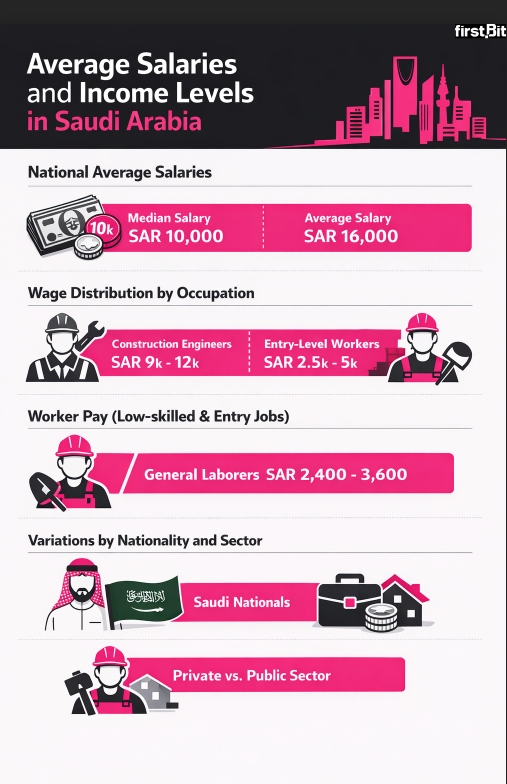
The average salary in Saudi Arabia varies across industries and professions. For those in the construction industry, understanding what is the average income in Saudi Arabia helps both employers and workers benchmark pay and compensation packages effectively.
Salaries differ greatly depending on the type of job and the level of expertise required. For instance, job salaries in Saudi Arabia for managerial roles or specialized positions can be significantly higher than for entry-level workers. This disparity is crucial to understand when asking, “What is the average income in Saudi Arabia?” across different sectors.
The average worker salary in Saudi Arabia is around SAR 16,000 per month, though this can vary greatly depending on the sector, experience level, and location. Job salaries in Saudi Arabia are typically higher for specialized positions, reflecting the demand for skilled workers [?] .
Wage Distribution by Occupation
Salaries in Saudi Arabia can also differ based on the occupation. For instance, while general laborers in construction might earn an entry-level salary, construction engineer salaries are often more competitive, reflecting their higher responsibilities and specialized skill sets. It depends on the experience and
types of projects that the construction engineers manage.
The average construction engineer salary in Saudi Arabia is around SAR 9,000 to SAR 12,000 per month. On the other hand, entry-level workers in the construction industry may earn between SAR 2,500 to SAR 5,000 per month. This is just one example of how Saudi Arabia’s job salaries can vary across different industries and roles.
Worker Pay (Low-skilled & Entry Jobs)
For lower-skilled and entry-level positions, worker salaries tend to be on the lower end of the scale. For example, general workers in the construction industry earn an average of SAR 2,400 to SAR 3,600 per month. However, skilled workers can earn significantly higher worker salaries, especially with years of experience or in specialized roles.
Salaries in this range typically apply to laborers or workers who do not require extensive technical skills. These roles are essential to the construction process but offer lower pay compared to skilled positions like engineers or project managers.
Variations by Nationality and Sector
Salaries can vary depending on nationality and sector. Saudi nationals often receive higher wages compared to expatriates. This is especially true in industries where Saudization efforts are emphasized, encouraging the hiring of local talent.
In the public sector, salary packages tend to be more standardized and often include additional benefits like housing allowances or bonuses, while private sector salaries may vary more based on the employer and the job role.
How FirstBit ERP Helps You Calculate Net Salary for Construction Workers in Saudi Arabia
Managing payroll in the construction industry can be complex due to varying salary components, deductions, and employee categories.
FirstBit ERP simplifies this process for construction companies in Saudi Arabia by automating salary calculations and ensuring compliance with local regulations.
FirstBit ERP is designed to help businesses accurately calculate net salary for their workforce, ensuring all components and mandatory deductions are handled correctly. Automating the process reduces errors and saves time, enabling construction companies to focus on core operations.
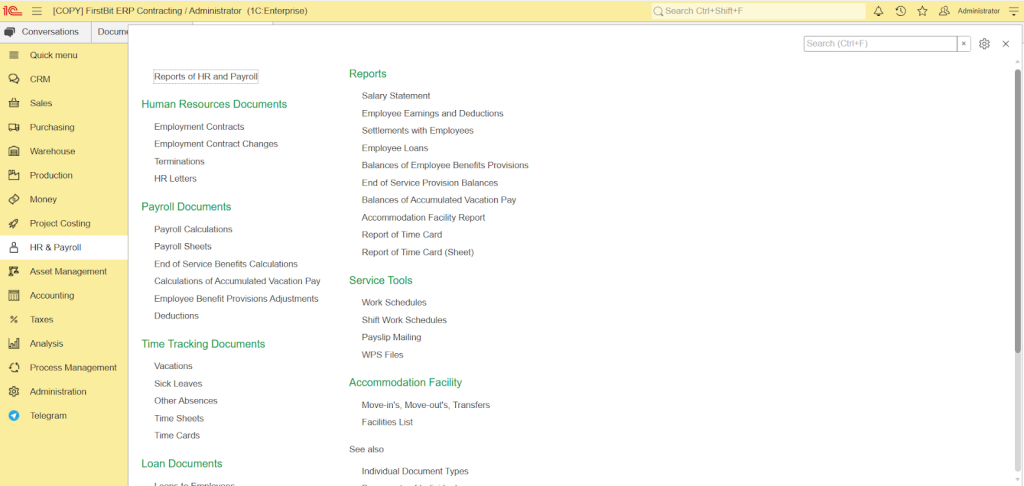
Automated Gross and Net Salary Calculation. FirstBit ERP automatically calculates gross salary, including basic salary, allowances, overtime, and bonuses, and then calculates the net salary after deducting GOSI, taxes, and other deductions.
Real-time Updates and Integration. The ERP system integrates with HR and finance modules, ensuring that any changes to employee details (e.g., salary adjustments, new allowances, etc.) are automatically reflected in the payroll, reducing errors and manual updates.
HR and Payroll module in FirstBit ERP
Compliance with Saudi Labor Laws. FirstBit ERP helps companies comply with Saudi Arabia’s labor laws by automatically calculating mandatory deductions like GOSI and unemployment insurance, as well as providing reports for regulatory audits.
Customizable Deductions. The system allows for customizable deductions, including optional deductions like savings plans, loans, and insurance premiums. This flexibility ensures that companies can manage diverse payroll structures effectively.
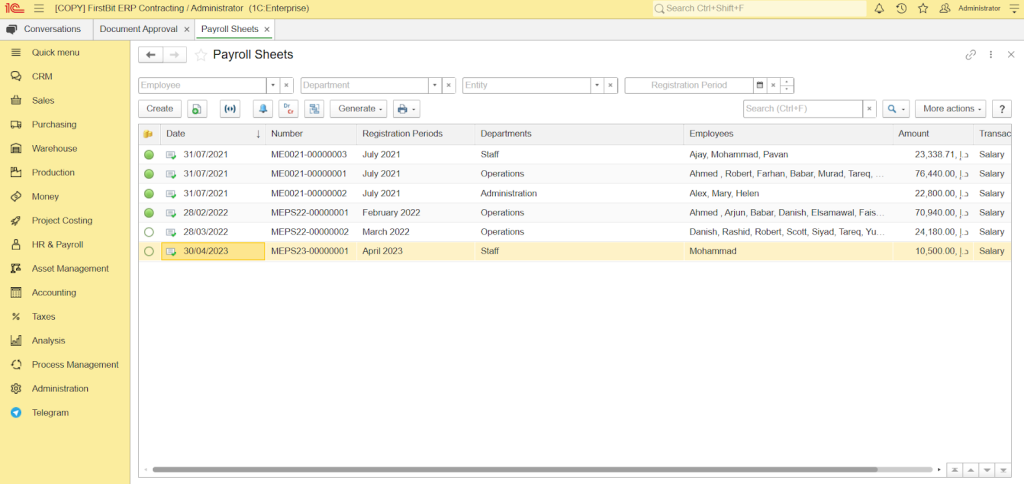
Comprehensive Reporting. FirstBit ERP provides detailed payroll reports, offering clear insights into earnings, deductions, and net salary. These reports help employees and employers review the salary breakdown, ensuring transparency and accuracy.
Payroll Sheets in FirstBit ERP
Enhanced Data Security. FirstBit ERP prioritizes data security, ensuring that all payroll and employee information is stored securely and can be accessed only by authorized personnel.
For construction companies,
FirstBit ERP provides a comprehensive and efficient payroll solution. It automates salary calculations and ensures compliance with Saudi labor laws, minimizing the administrative burden and reducing the risk of errors. The system provides clear, transparent payslips for employees, improving satisfaction and trust in the payroll process.
Conclusion
Understanding net salary calculation in Saudi Arabia is essential, especially in industries like construction, where salary structures can be complex. Knowing the components of a salary helps employees ensure fair compensation and allows employers to streamline payroll processes.
With tools like
FirstBit ERP, managing salary calculations becomes more efficient and transparent, reducing administrative burden and minimizing errors. Accurate salary calculations not only ensure compliance with Saudi Labor Laws but also create a more transparent and productive work environment for both employers and employees.
FAQ
How to calculate salary in Saudi Arabia?
To calculate salary in Saudi Arabia, start with the gross salary, which includes the basic salary, allowances, overtime, and bonuses. Then, subtract mandatory deductions like GOSI and taxes to get the net salary, which is the actual amount the employee takes home.
What is the formula for salary?
The formula for salary calculation is:
Basic Salary + Allowances + Overtime + Bonuses = Gross Pay
Gross Pay - Deductions (e.g., GOSI, taxes) = Net Salary
What is the difference between gross and net salary in KSA?
Gross salary includes all earnings before deductions (basic salary, allowances, overtime, bonuses), while net salary is the amount left after mandatory deductions like GOSI, taxes, and any optional deductions. The net salary is what the employee receives.
Umme Aimon Shabbir
Editor at First Bit
Aimon brings a deep understanding of the modern construction business to her articles. Her strength is providing practical content that enhances users’ understanding and usage of the software in the industry. As an editor, Aimon helps our authors reach their full potential and produce their best work.










'%3e%3cg%20clip-path='url(%23clip1_6548_6055)'%3e%3cpath%20d='M13.974%2015.6195C14.2724%2016.0185%2014.6532%2016.3487%2015.0905%2016.5876C15.5278%2016.8265%2016.0114%2016.9686%2016.5084%2017.0042C17.0055%2017.0398%2017.5043%2016.9681%2017.9712%2016.7939C18.4381%2016.6198%2018.8621%2016.3472%2019.2143%2015.9948L21.2994%2013.9098C21.9324%2013.2544%2022.2827%2012.3766%2022.2747%2011.4654C22.2668%2010.5543%2021.9014%209.68269%2021.257%209.03839C20.6127%208.39408%2019.7412%208.02862%2018.83%208.0207C17.9189%208.01278%2017.0411%208.36305%2016.3857%208.99606L15.1902%2010.1845M16.754%2014.2295C16.4555%2013.8305%2016.0747%2013.5003%2015.6374%2013.2614C15.2002%2013.0225%2014.7166%2012.8804%2014.2196%2012.8448C13.7225%2012.8092%2013.2237%2012.8809%2012.7568%2013.0551C12.2899%2013.2292%2011.8659%2013.5018%2011.5136%2013.8542L9.42861%2015.9392C8.7956%2016.5946%208.44534%2017.4724%208.45326%2018.3836C8.46117%2019.2947%208.82664%2020.1663%209.47094%2020.8106C10.1152%2021.4549%2010.9868%2021.8204%2011.898%2021.8283C12.8091%2021.8362%2013.6869%2021.4859%2014.3423%2020.8529L15.5308%2019.6645'%20stroke='%235F7896'%20stroke-width='1.39002'%20stroke-linecap='round'%20stroke-linejoin='round'/%3e%3c/g%3e%3c/g%3e%3crect%20x='0.438953'%20y='0.438953'%20width='28.9709'%20height='28.9709'%20rx='14.4855'%20stroke='%235F7896'%20stroke-width='0.877907'/%3e%3cdefs%3e%3cclipPath%20id='clip0_6548_6055'%3e%3crect%20width='29.8488'%20height='29.8488'%20rx='14.9244'%20fill='white'/%3e%3c/clipPath%3e%3cclipPath%20id='clip1_6548_6055'%3e%3crect%20width='16.6802'%20height='16.6802'%20fill='white'%20transform='translate(7.02344%206.58435)'/%3e%3c/clipPath%3e%3c/defs%3e%3c/svg%3e)