


How to Build and Manage a High-Converting Sales Pipeline for Construction Companies in Saudi Arabia
23 Feb 2026
•
10 min read

Umme Aimon Shabbir
Editor at First Bit
In Saudi Arabia’s fast-paced construction sector, securing high-value projects is more competitive than ever. For construction companies looking to stay ahead, building a high-converting sales pipeline is essential. A well-defined pipeline enables businesses to identify the most promising opportunities, track progress, and ensure that no leads slip through the cracks.
A solid sales pipeline CRM system can dramatically improve sales outcomes. Companies that use CRM systems experience up to a 29% boost in sales performance and more accurate forecasts, proving that pipeline management is not just a strategy, it’s a competitive advantage [?] .
In this article, we’ll break down how to build a sales pipeline specifically for the construction industry, focusing on the steps and tools that will help companies optimise every stage of the sales cycle. From capturing leads to closing deals, these insights will help you turn potential into profit.
What is a Sales Pipeline?
A sales pipeline is a visual representation of where potential customers are in the sales process, from first engagement to closing the deal. It provides construction companies with a snapshot of all active opportunities, outlines the necessary actions, and tracks the progress of each lead. This clarity is beneficial in sectors with long, complex sales cycles and multiple decision‑makers.
In practice, a sales pipeline breaks the sales journey into defined stages such as lead generation, qualification, proposal, negotiation, and closing. By organising opportunities into these stages, teams can prioritise effectively, assess progress, and make better revenue forecasts. A clear pipeline also makes it easier to identify bottlenecks before they affect results.
Research in emerging markets shows that CRM tools, the systems used to track and manage sales pipelines, help streamline sales processes, enhance customer data management, and improve overall sales performance by enabling teams to act on insights rather than intuition [?] .
Understanding this foundation sets the stage for exploring how to build a sales pipeline that supports conversion and sustained sales growth.
How to Build a Sales Pipeline

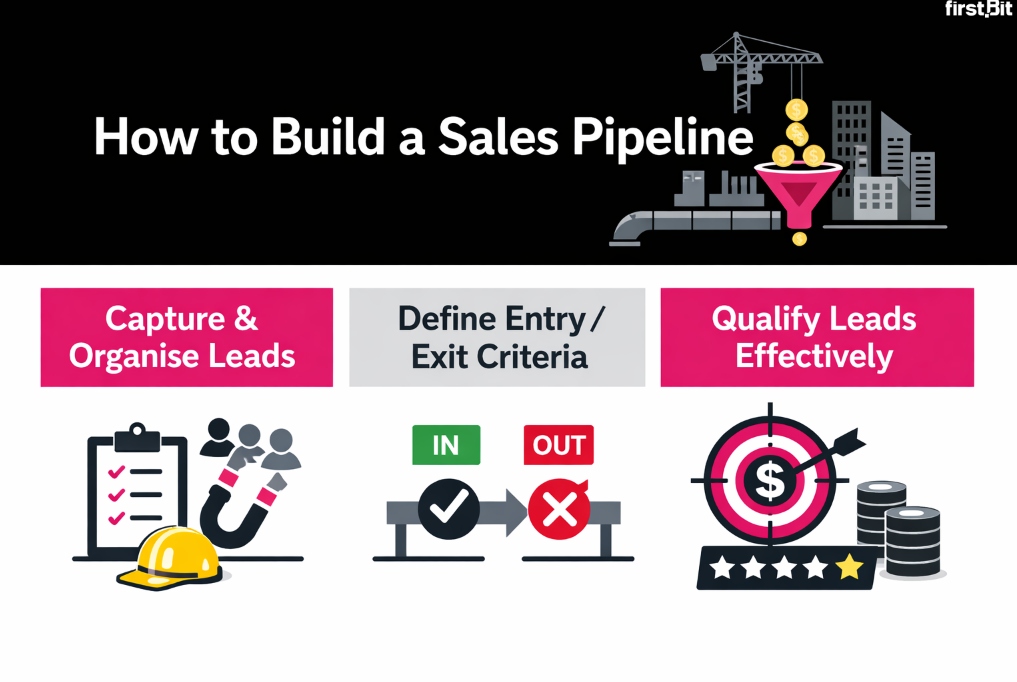
Steps to build a sales pipeline
Building a sales pipeline is the first step towards a streamlined and efficient sales process. For construction companies in Saudi Arabia, having a pipeline that is both practical and adaptable to the unique needs of the industry is essential. A strong pipeline not only helps in managing leads but also ensures that opportunities are maximised and conversions are consistently achieved.
In this section, we’ll break down the key steps to building a sales pipeline tailored for the construction sector, highlighting actions that lead to improved efficiency, clearer forecasting, and higher conversion rates.
Step 1 — Capture and Organise Leads
The first step in building a sales pipeline is capturing leads from all possible sources. These could include inbound inquiries from your website, leads from trade shows, referrals from existing clients, or even cold outreach campaigns. For construction companies, lead generation could also come from industry partnerships or networking events.
Once you’ve captured these leads, it’s crucial to organise them in a way that’s easy to manage and track. This is where a sales pipeline CRM comes in handy. It centralises all the lead data, ensuring that each lead is assigned to the appropriate sales representative and tracked as it progresses through the pipeline stages [?] .
Efficient lead capture and organisation improve not only your team's ability to follow up, but also the quality of your forecasting. The key to success in this step is ensuring data accuracy. Make sure that leads are categorised correctly, and all relevant contact information is up-to-date. This will save time down the line and help prevent potential confusion when moving leads through different stages.
Step 2 — Define Clear Entry/Exit Criteria
One of the most important steps in building a sales pipeline is defining clear entry and exit criteria for each stage. This means establishing specific conditions that a lead must meet to move from one stage to the next, from initial contact to qualification, from proposal to negotiation, and finally, from negotiation to closing the deal.
For construction companies, entry criteria could include factors like project size, budget, and timeline, while exit criteria might be based on client commitment, contract agreement, or finalizing project details. By setting these criteria, you reduce subjectivity and ensure that only leads with real potential move through the pipeline.
Clearly defined criteria also enable sales teams to focus their efforts on high-priority opportunities, reducing wasted time and improving overall conversion rates. Additionally, it allows your CRM system to automatically trigger updates or alerts when a lead meets or fails to meet the defined criteria, keeping the process moving smoothly.
Step 3 — Qualify Leads Effectively
Not all leads are equally valuable, so effective lead qualification is crucial for building a successful sales pipeline. In the construction industry, projects vary greatly in size, budget, and complexity, making it essential to identify which leads are worth pursuing.
One effective method for qualification is lead scoring, which ranks leads based on factors like project scope, budget, and timeline. This allows sales teams to prioritise leads that are more likely to convert, focusing efforts on the most promising opportunities.
Lead scoring helps ensure resources are spent efficiently, reducing wasted time on low-quality leads and increasing the likelihood of closing high-value deals. By implementing this process, construction companies can streamline their sales efforts and boost conversion rates.
Sales Pipeline Management and Optimization
Once your sales pipeline is built, managing and optimising it becomes key to ensuring continued success. An organised pipeline is only effective if it’s actively maintained, tracked, and fine-tuned based on performance data. Effective sales pipeline management ensures that deals are moving through the pipeline efficiently, and opportunities aren't lost due to mismanagement or oversight [?] .
In this section, we’ll explore the best practices for managing your sales pipeline, including maintaining pipeline hygiene, using analytics to track performance, and standardising processes to ensure consistency. Each of these practices contributes to higher conversion rates and more predictable revenue growth.
Maintain Pipeline Hygiene
Maintaining pipeline hygiene is crucial for keeping your sales process efficient and your forecasts accurate [?] . This involves regularly reviewing the pipeline, removing inactive deals, and updating deal statuses, deadlines, and values.
Inactive or outdated deals should be cleared to prevent clutter, ensuring that the team focuses only on high-value opportunities. Reassigning ownership or updating deal details also helps keep everything aligned and reduces confusion.
Regular pipeline cleaning not only keeps your sales process organised but also ensures that forecasts are based on real, current data. This practice allows your team to concentrate on viable leads, ultimately improving conversion rates and sales performance.
Use Analytics to Track Key Metrics
Tracking key metrics is essential for optimising your sales pipeline and identifying areas for improvement. Metrics like conversion rates, pipeline velocity, and average deal size offer valuable insights into the performance of your sales pipeline at each stage.
For construction companies, analysing metrics such as stage-by-stage performance and win/loss ratios helps uncover bottlenecks and slowdowns early. This enables teams to adjust their approach and address issues before they affect the overall sales process.
By utilizing real-time data and analytics, you can make informed, data-driven decisions to refine your pipeline, resulting in improved outcomes and enhanced sales performance. This approach ensures that your pipeline remains efficient and consistently delivers results.
Standardize Process and Cadences
Standardising your sales process is crucial for maintaining a consistent and high-converting sales pipeline. This includes creating repeatable follow-up sequences, establishing communication templates, and defining the exact steps each lead must follow as it progresses through the pipeline.
By setting a standard cadence for follow-ups, check-ins, and proposal submissions, your team can ensure that no opportunities are overlooked. A structured process also reduces errors and improves the efficiency of your sales cycle, helping to maintain momentum.
Standardising your sales pipeline management makes it easier to scale as your team grows. New team members can quickly adapt to a proven process, allowing for smooth transitions and continued success in pipeline conversions.
Sales Pipeline CRM
A sales pipeline CRM is a tool that centralises all your lead and deal information in one place, allowing sales teams to manage and track opportunities efficiently. For construction companies, choosing the right CRM can significantly enhance sales pipeline management by automating key tasks, improving collaboration, and providing real-time insights into pipeline performance.
In this section, we’ll explore how to choose the right CRM for your construction business and how automation can streamline your pipeline management, helping your team focus on what matters most: closing deals.
Choosing the Right CRM
When selecting a sales pipeline CRM, it’s important to consider features that align with your company’s needs. Look for a CRM that offers pipeline visualisation, automation capabilities, and forecasting tools. A clear visual representation of your pipeline helps sales teams quickly identify where each lead stands and what actions are required next.
The right CRM should also centralise communication, integrating email, calls, and meetings in one platform. This streamlines communication and ensures that every interaction with a lead is recorded and easily accessible. This reduces errors, improves data accuracy, and enhances team collaboration, ensuring a seamless sales process.
Ultimately, the best CRM for your construction business is one that adapts to your unique processes and enables efficient tracking of sales pipeline management. With the right tool, your team can work smarter, not harder, boosting conversion rates and improving overall sales performance.
Automating Pipeline Workflows
Automation within your sales pipeline CRM can save valuable time and increase efficiency by handling repetitive tasks, allowing sales reps to focus on high-value activities. Features like follow-up triggers, automatic stage updates, and task notifications ensure that leads are consistently nurtured without requiring manual intervention.
By automating workflows, your team can ensure timely follow-ups, reduce the chances of missed opportunities, and maintain momentum in the pipeline. Automated reminders for proposals, meetings, and contract renewals help keep your sales cycle moving smoothly, preventing delays and improving response times.
Implementing automation into your pipeline processes also improves consistency across the team. With predefined workflows and notifications, every rep follows the same steps, ensuring that your pipeline management remains efficient and scalable. This consistency ultimately leads to higher conversion rates and a more predictable sales process.
FirstBit ERP — Professional Overview of Capabilities for Sales Pipeline Management
FirstBit ERP is a comprehensive enterprise resource planning platform tailored to construction companies. It integrates core business functions, including CRM, into a unified system designed to improve operational visibility, data consistency, and process efficiency across sales, finance, procurement, and project execution.
Key capabilities that support sales pipeline management within FirstBit ERP include:
- Integrated leads pipeline module. First Bit includes a leads pipeline feature that allows recording and managing inquiries from capture through tendering and quotation stages, maintaining all interactions and activities in one place.
- Centralised client information. The CRM module centralises client, communication, estimation, quotation, and email histories, enabling teams to track every interaction and follow‑up effectively.
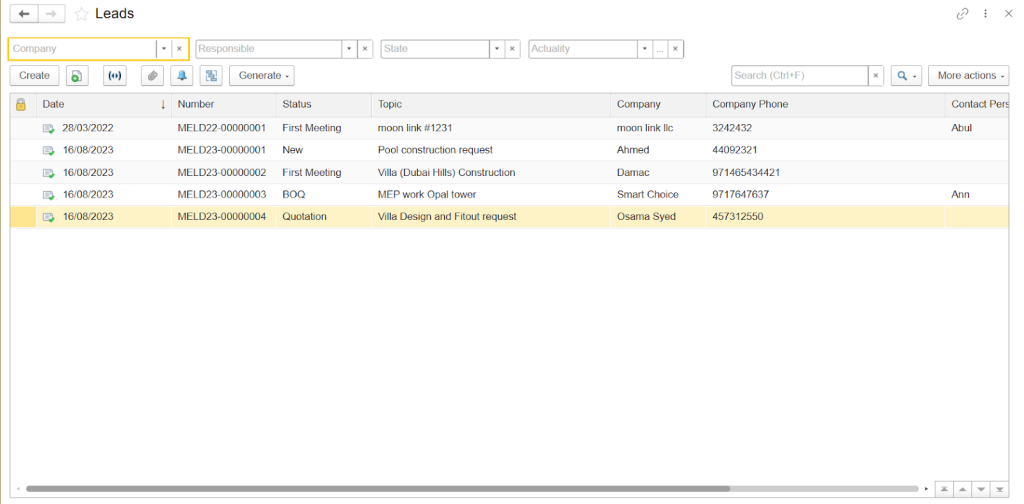
CRM Leads from different companies in FirstBit ERP
- Activity planning and scheduling. Users can assign responsible managers, plan calendar activities (site visits, calls, follow‑ups), and ensure timely engagement with leads.
- Real‑time interaction tracking. Interaction histories and document logs are maintained within the system, improving transparency and reducing the risk of communication lapses.
- Automated notifications and updates. The platform supports automated alerts for calendar activities and approvals, helping sales teams stay on top of key pipeline events.
- Integration with estimation and quotation tools. First Bit connects pipeline data to project estimation and quotation functions, enabling smoother transitions from lead to proposal to contract.
- Cross‑functional data integration. Because it’s an ERP, pipeline data links with finance, project cost, and operations modules, providing a broader view of how a lead or deal influences overall business performance.
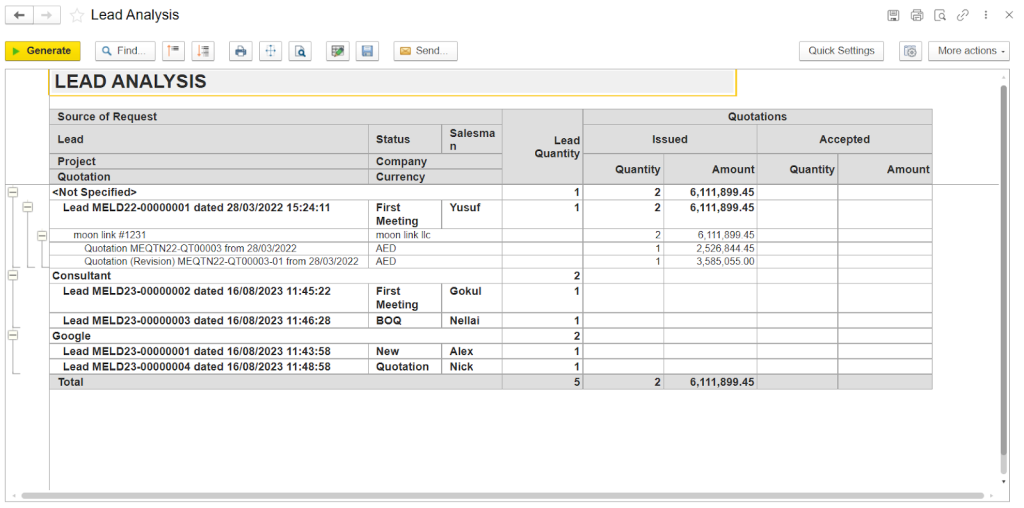
Lead Analysis in FirstBit ERP
These features position FirstBit ERP as a practical choice for construction companies that want to manage their sales pipeline alongside financials, operations, and project workflows rather than relying on a standalone CRM system.
Conclusion
Building and managing an effective sales pipeline is a crucial strategy for construction companies looking to drive predictable revenue and maintain growth in a competitive market. By carefully structuring the pipeline, qualifying leads, and optimising workflows, construction businesses can ensure that valuable opportunities are maximised and conversion rates are consistently high.
Continuous optimisation is key. Maintaining pipeline hygiene, refining your qualification process, and integrating the right CRM tools help adapt to changing market conditions and evolving customer needs. A system like FirstBit ERP enables teams to track progress, improve communication, and make data-driven decisions that drive success.
As construction companies embrace these best practices, they can transform their sales process from a reactive, fragmented effort into a streamlined, high-performance engine. By doing so, they position themselves not only to win more deals but also to build long-term client relationships that fuel growth well into the future.
FAQ
What is a sales pipeline?
What are the stages in a sales pipeline?
What are the 7 stages of sales?
How to build a pipeline from scratch?

Umme Aimon Shabbir
Editor at First Bit
Share this article
'%3e%3cg%20clip-path='url(%23clip1_6548_6055)'%3e%3cpath%20d='M13.974%2015.6195C14.2724%2016.0185%2014.6532%2016.3487%2015.0905%2016.5876C15.5278%2016.8265%2016.0114%2016.9686%2016.5084%2017.0042C17.0055%2017.0398%2017.5043%2016.9681%2017.9712%2016.7939C18.4381%2016.6198%2018.8621%2016.3472%2019.2143%2015.9948L21.2994%2013.9098C21.9324%2013.2544%2022.2827%2012.3766%2022.2747%2011.4654C22.2668%2010.5543%2021.9014%209.68269%2021.257%209.03839C20.6127%208.39408%2019.7412%208.02862%2018.83%208.0207C17.9189%208.01278%2017.0411%208.36305%2016.3857%208.99606L15.1902%2010.1845M16.754%2014.2295C16.4555%2013.8305%2016.0747%2013.5003%2015.6374%2013.2614C15.2002%2013.0225%2014.7166%2012.8804%2014.2196%2012.8448C13.7225%2012.8092%2013.2237%2012.8809%2012.7568%2013.0551C12.2899%2013.2292%2011.8659%2013.5018%2011.5136%2013.8542L9.42861%2015.9392C8.7956%2016.5946%208.44534%2017.4724%208.45326%2018.3836C8.46117%2019.2947%208.82664%2020.1663%209.47094%2020.8106C10.1152%2021.4549%2010.9868%2021.8204%2011.898%2021.8283C12.8091%2021.8362%2013.6869%2021.4859%2014.3423%2020.8529L15.5308%2019.6645'%20stroke='%235F7896'%20stroke-width='1.39002'%20stroke-linecap='round'%20stroke-linejoin='round'/%3e%3c/g%3e%3c/g%3e%3crect%20x='0.438953'%20y='0.438953'%20width='28.9709'%20height='28.9709'%20rx='14.4855'%20stroke='%235F7896'%20stroke-width='0.877907'/%3e%3cdefs%3e%3cclipPath%20id='clip0_6548_6055'%3e%3crect%20width='29.8488'%20height='29.8488'%20rx='14.9244'%20fill='white'/%3e%3c/clipPath%3e%3cclipPath%20id='clip1_6548_6055'%3e%3crect%20width='16.6802'%20height='16.6802'%20fill='white'%20transform='translate(7.02344%206.58435)'/%3e%3c/clipPath%3e%3c/defs%3e%3c/svg%3e)


Related articles


See all




See FirstBit ERP solutions in action
Discover how our system solves the unique challenges of contractors in a personalized demo.
After the demo you will get a quotation for your company.